
TL;DR: The dominant FoodTech business model — the 25-35% aggregator commission — burned through billions of euros between 2015 and 2023 before DoorDash and Deliveroo finally reached profitability in 2024. But that profitability masks a structural reality: the fixed-subscription OS platform model (ChowNow, Olo) delivers gross margins of 60-75% on SaaS revenue, versus 1-2% EBITDA margins on GTV for aggregators. DoorDash’s acquisition of Deliveroo for £2.9 billion in 2025 confirms the forced consolidation of a model that survived only through critical mass. In Algeria, Nresto.com is testing a third path: a free digital menu monetized through contextual advertising, integrated into the Felhanout delivery ecosystem. The future may be neither commission nor subscription, but attention.
- When billions burned finally produce… a first profit
- Anatomy of the aggregator model: how 30% restaurant delivery commission generates 1-2% margin
- The winner-take-all myth: why DoorDash had to buy Deliveroo
- The silent alternative: the OS platform model at 0% commission
- Two architectures, two logics: beware of comparison bases
- The concrete impact on an independent restaurant
- The geographic shift 2024-2026: Europe pivots, America resists, Algeria innovates
- Europe: regulatory pressure accelerates the migration
- United States: DoorDash reigns, but cracks are appearing
- Southeast Asia: why the aggregator model works there (for now)
- Algeria: how Nresto.com is exploring a third FoodTech business model
- Nresto’s three-phase strategy: from free distribution to FMCG monetization
- Sensitivity analysis: impressions across three scenarios
- Nresto revenue per restaurant: three scenarios with realistic advertising variables
- Comparative profitability: three models, three trajectories
- Replicability: where can the hybrid model be exported?
- Burn rate and sustainability: the late profitability paradox
- FoodTech outlook 2028: three scenarios for the future of the delivery business model
- FAQ: FoodTech Business Model 2026 — The Essential Questions
- How to estimate your real restaurant delivery commission from an aggregator in 2026?
- Is the OS platform model more capital-efficient?
- Should a restaurant leave Deliveroo for an OS platform?
- Why does DoorDash remain dominant in the USA?
- Is the Nresto.com model (free menu + contextual advertising) viable?
- What’s the best FoodTech business model for a founder in 2026?
- Does DoorDash’s acquisition of Deliveroo change the game?
- The FoodTech verdict 2026: when math and culture determine the winner
When billions burned finally produce… a first profit
Let’s be honest from the start. When I began analyzing startup business models in FoodTech for this article, I expected to write an indictment of the aggregator model. The historical numbers practically demanded it: Deliveroo had accumulated over £1.5 billion in cumulative operating losses between 2020 and 2023 according to its 2024 annual report. DoorDash, despite tens of billions of dollars in GMV in 2023, was still posting an operating loss of $558 million according to its annual financial results. Just Eat Takeaway was drowning under billions of euros in post-acquisition debt.
And then 2024 arrived. DoorDash recorded its first annual net profit: $117 million on $10.72 billion in revenue. Deliveroo posted a statutory profit of £2.9 million — modest, certainly, but a first profit after eleven years of losses. It was as if an exhausted marathoner had finally crossed the finish line… only to discover a sprinter had been waiting on the other side, relaxed and profitable for years.
That sprinter is the OS platform model — the startup that raises little, charges a fixed subscription, and lets the restaurant keep 100% of its revenue. ChowNow in the United States (22,000 restaurants according to its public communications, $64 million raised). Olo (publicly traded, serving tens of thousands of restaurants per its SEC filings). And in Algeria, a player that appears in no CB Insights report but is exploring a radically different approach: Nresto.com.
Ressource recommandée
Executive Discipline System — le template Notion des fondateurs lucides
Un système opérationnel conçu pour structurer la discipline quotidienne,
clarifier les priorités et maintenir une exécution constante dans des contextes
de forte pression.
Pensé pour les fondateurs, dirigeants et profils exécutifs — pas pour la motivation,
mais pour la tenue dans la durée.
Here’s the question nobody is asking: if the aggregator model finally found profitability after burning through billions, is that a victory — or proof that a structurally better path exists?
Glossary — to read this article without ambiguity
GTV / GMV (Gross Transaction Value / Gross Merchandise Value): total value of orders placed on the platform, including the restaurant’s share + fees. This is the “apparent revenue” — but it’s not the platform’s actual revenue.
Revenue (platform revenue): what the platform actually retains — commissions + service fees + delivery fees. At Deliveroo, revenue represents approximately 50% of GTV. At DoorDash, approximately 13% of GMV (due to a different accounting method).
Take rate: percentage of GTV/GMV captured by the platform as revenue.
Contribution margin: margin after deducting direct variable costs (courier, payment, support) per order.
Adjusted EBITDA: earnings before interest, taxes, depreciation, and amortization — and often before stock-based compensation. This is the metric platforms use to announce their “profitability” (take it with a grain of salt).
SaaS gross margin: calculated on revenue (subscription), not on GMV. A 70% SaaS gross margin and a 2% EBITDA margin on GTV are not comparable — they measure different things on different bases.
Fill rate (ads): percentage of ad placements actually sold to an advertiser. A 30% fill rate means 70% of available impressions generate no revenue.
Anatomy of the aggregator model: how 30% restaurant delivery commission generates 1-2% margin
To understand the dominant business model in food delivery, let’s dissect a typical €30 order. The model below is a simplified estimate based on public data from Deliveroo and DoorDash — the goal is structural, not accounting. It doesn’t claim to represent the exact costs of every order, but illustrates the economic dynamics of the aggregator model as it operates in Europe in 2024.
Chez les athlètes de haut niveau, la discipline n’est pas une question de motivation. C’est un système : des routines, des séquences, un cadre auquel on revient quand la pression monte et que le chaos s’installe.
L’Executive Discipline System applique cette logique au quotidien des fondateurs et dirigeants : structurer l’exécution, maintenir la clarté mentale, et continuer à avancer même après un “match perdu”.
Voir le système →On the revenue side, the platform collects approximately €9 in restaurant commission (30%), €2.99 in customer delivery fees, and €3 in service fees (10%). Total: approximately €15 in gross revenue. On the variable cost side, courier payment represents €5 to €7 — a physical reality that’s difficult to compress, since the courier must travel from restaurant to customer regardless of overall volume. Customer incentives (20%, 30% off promotions) cost €2 to €4 per order during active competition phases. Operational support, payment processing, and refunds add another €2 to €3.
Historical result through 2023: a contribution margin that was often negative, ranging from -1% to -15% per order depending on market phase and promotional intensity. The investors’ promise came down to one sentence: “Scale will fix unit economics.” Translation: once we have enough volume, costs will dilute and margin will turn positive.
Simplified model: where the €15 from a typical order disappears
| P&L Line — €30 Order (estimate) | Mature market | Promo war |
|---|---|---|
| Platform revenue | ||
| Restaurant commission (30%) | +€9.00 | +€9.00 |
| Customer delivery fee | +€2.99 | +€0.99 (promo) |
| Service fee (10%) | +€3.00 | +€3.00 |
| Total revenue | +€14.99 | +€12.99 |
| Direct variable costs | ||
| Courier payment (range: €5-7) | -€5.50 | -€6.50 |
| Customer incentives (range: €0-6) | -€2.00 | -€5.00 |
| Ops, support, fraud, refunds | -€2.50 | -€2.50 |
| Payment processing (~2%) | -€0.60 | -€0.60 |
| Allocated costs (semi-fixed, distributed per order — editorial approximation) | ||
| Tech, R&D, marketing (estimated allocation) | -€3.00 | -€4.00 |
| Broad contribution margin (with allocation) | +€0.39 to +€2.39 (+1 to +8%) | -€3.61 to -€7.61 (-12 to -25%) |
Methodological note: tech, R&D, and marketing costs are not variable costs in the strict sense — they are semi-fixed costs allocated per order to illustrate the complete structure. The variable cost ranges (courier €5-7, incentives €0-6) explain the margin interval shown. Figures are estimated from Deliveroo’s 2024 annual report and DoorDash’s Q4 2024 results. The table’s purpose is structural: to show why margins remain fragile, not to simulate an auditable P&L.
The contrast between the two scenarios is revealing. In a mature market, without a price war, the broad contribution margin oscillates between 1 and 8% per order — fragile but positive. As soon as competition intensifies, it plunges into negative territory. This is what made the aggregator model heavily dependent on consolidation: in most cases, serious price competition tends to destroy profitability.
And in 2024, that promise of volume was partially realized. DoorDash generated $1.8 billion in adjusted EBITDA for a net profit of $117 million — approximately 1.1% net margin per its Q4 2024 financial results. Deliveroo generated £140 million in adjusted EBITDA on £7.1 billion in GTV — approximately 2% EBITDA margin on GTV, per its 2024 annual report. Eleven years, £1.5 billion raised, massive restructurings, market exits (Spain, Netherlands, Australia, Hong Kong, then Qatar and Singapore in February 2026)… for a 2% margin.
It’s like building a €2 billion hydroelectric dam that generates enough electricity to power… an LED light bulb. An exaggeration? Certainly. But the image illustrates a real structural point: even if the dam works and could eventually power an entire village, you can legitimately wonder whether a rooftop solar panel might have been more rational for the first inhabitants.
The winner-take-all myth: why DoorDash had to buy Deliveroo
The initial VC thesis between 2015 and 2019 rested on an attractive premise: the food delivery market is a winner-take-all market. The first aggregator to reach critical mass in each geography wins everything. Competitors die. Margins follow. This thesis justified massive fundraises: approximately $5.5 billion for DoorDash per its SEC filings, £1.7 billion for Deliveroo, over $1 billion for Glovo.
Ten years later, the verdict is clear: there was no winner-take-all. There was a winner-buys-all. In May 2025, DoorDash announced the acquisition of Deliveroo for £2.9 billion (~$3.7 billion) — ending the independent existence of the British champion, valued at £7.6 billion during its 2021 IPO. The deal, finalized on October 2, 2025, immediately triggered a wave of rationalization: in February 2026, DoorDash announced Deliveroo’s withdrawal from Qatar and Singapore, as well as the closure of Wolt in Japan and Uzbekistan. Consolidation is not a sign of strength. It’s an admission that the aggregator model tends to require a near-absolute dominant position to turn 1-2% margins into long-term viability.
Delivery Hero had already acquired Glovo in 2022. Prosus bought Just Eat Takeaway. The market is converging toward 2-3 global players not because the model is brilliant, but because it’s structurally fragile: the slightest price competition — customer promotions, commission reductions — tends to destroy already thin margins. And even after consolidation, the new owner’s first decision is to close unprofitable markets. When your post-acquisition strategy consists of shrinking your geographic footprint, the question deserves to be asked: are you growing, or shrinking intelligently?
The silent alternative: the OS platform model at 0% commission
While aggregators were burning through billions, a radically different model was quietly building viability. The OS platform model — sometimes called SaaS delivery or first-party ordering — rests on a simple principle: sell technology to the restaurant via a fixed monthly subscription, without taking any commission on sales.
An important clarification: the aggregator and the OS platform are not two versions of the same product. The aggregator buys consumer demand and resells it to the restaurant for a commission. The OS platform sells a technology tool. These are competing economic architectures, not substitutable ones — which makes directly comparing their margins structurally misleading.
ChowNow, founded in 2011 in Los Angeles, embodies this model. With 22,000 partner restaurants according to its public communications and $64 million in total funding, the platform charges between $119 and $298 per month per its pricing page. Zero commission on sales. The restaurant keeps 100% of its revenue, controls its customer data, and manages its own delivery or uses integrated third-party services.
As ChowNow CEO Chris Webb explained: “We don’t take a cut, actually, at all. We just make money off that monthly fee.” A model so simple it seems naive next to the aggregators’ billions. Except the unit economics tell a very different story.
Two architectures, two logics: beware of comparison bases
| Metric | Aggregator (Deliveroo 2024) | OS Platform (ChowNow) |
|---|---|---|
| Total capital raised | ~£1.5B (source: annual reports) | $64M (Crunchbase) |
| Time to first profit | 11 years (2013-2024) | Estimated 3-5 years (not publicly confirmed) |
| Key margin metric | ~2% adjusted EBITDA / GTV | ~60-70% gross margin / SaaS revenue |
| Calculation base (not comparable) | % of GTV (gross order value) | % of revenue (subscriptions collected) |
| Restaurant commission | 25-35% | 0% |
| Customer data | Owned by platform | Owned by restaurant |
| Partner restaurants | ~186,000 (2024 annual report) | 22,000+ (public communications) |
These two models cannot be compared “margin vs. margin.” The aggregator handles massive financial flows (GTV) but retains only a fraction. The OS platform receives modest but predictable revenue, of which it retains most. What is comparable, however, is capital efficiency — the amount of capital required to reach profitability — and that’s where the gap becomes striking.
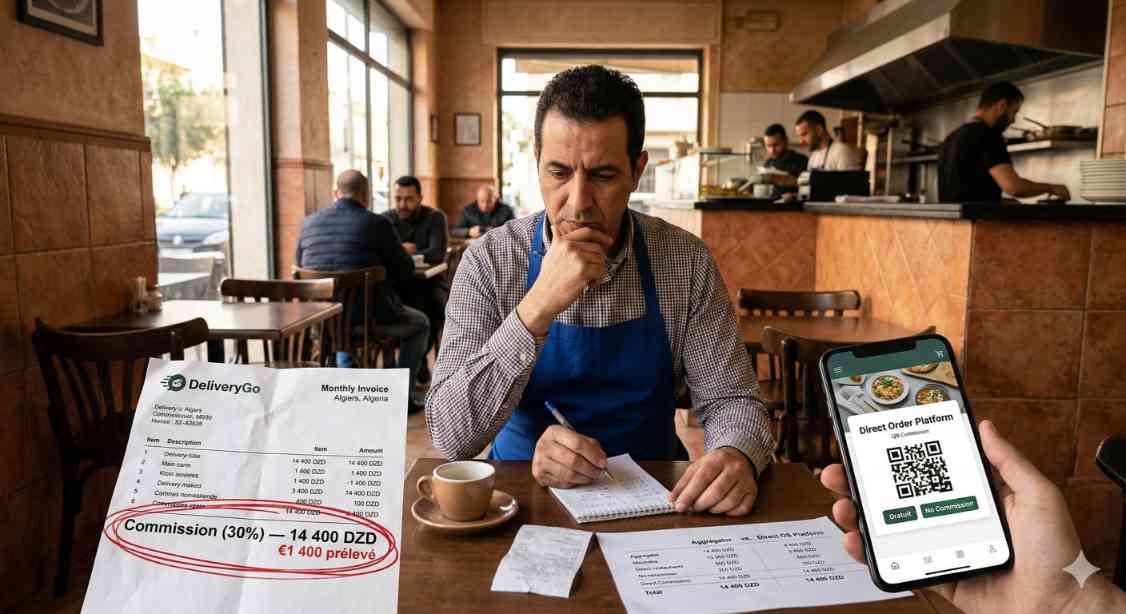
A restaurant generating €5,000 in monthly GMV via an aggregator pays approximately €1,500 in commission (30%). The same restaurant on an OS platform pays €199 in subscription — that’s roughly €1,300 in savings per month. In an industry where net margins hover between 3 and 8%, that’s often the difference between surviving and thriving.
The concrete impact on an independent restaurant
Let’s take a typical independent restaurant — a burger joint or pizzeria in a mid-sized European city — with €80,000 in monthly revenue, 60% of which comes from delivery (€48,000 in delivery GMV). Production costs (ingredients, labor, packaging) represent approximately 65% of GMV, or €31,200.
With an aggregator at 30% commission, the restaurant pays €14,400. Delivery gross margin: approximately €2,400, or 5%. On its dine-in activity (€32,000 with no commission), the same margin reaches 40%. The restaurant makes 8 times more margin on a dine-in customer than on a delivered one. But the dependency is there: post-COVID, delivery’s share has structurally embedded itself, and turning back seems unlikely.
With an OS platform at €199/month (and own or third-party couriers at ~€2 per delivery), the same restaurant keeps virtually all its revenue. Its delivery margin jumps from approximately 5% to 20-25%. That’s the difference between funding a unicorn’s growth and funding your own restaurant.
The geographic shift 2024-2026: Europe pivots, America resists, Algeria innovates
The transition from the aggregator model to the OS platform model is not happening uniformly. It follows geographic, cultural, and regulatory fault lines that every FoodTech founder must analyze before choosing a business model.
Europe: regulatory pressure accelerates the migration
Three factors are converging in Europe to weaken the aggregator model. First, the reclassification of couriers as employees — in the UK (Uber Supreme Court ruling 2021), in France (employment presumption), in Spain (Riders Law 2021) — has significantly increased the cost per delivery. Estimates vary by market and study, but the order of magnitude reported by the platforms themselves is a substantial increase in courier-related costs. Second, European restaurateurs’ culture of independence makes extracting 30% structurally more painful than in more franchised markets. Finally, SaaS platforms and white-label solutions are emerging to offer restaurants credible alternatives.
DoorDash’s acquisition of Deliveroo in 2025 confirms that the European aggregator model could hardly survive independently. Deliveroo had already exited Spain (2021), the Netherlands and Australia (2022), and Hong Kong (2025). Consolidation is an admission: in the European context, only a near-monopoly position seems capable of making those 1-2% margins viable long-term.
United States: DoorDash reigns, but cracks are appearing
DoorDash dominates the American market with an estimated share between 65 and 67% according to industry analyses (Bloomberg Second Measure, Edison Trends). The network effects are powerful: consumption habits are entrenched, the psychological switching cost is high, and labor regulation remains relatively favorable to the gig economy (Proposition 22 in California).
But ChowNow, with its 22,000 restaurants, represents a disintermediation signal. Its message — “support local, not Silicon Valley” — resonates with independent restaurateurs tired of seeing 30% of their revenue captured by a platform. Toast (NYSE-listed) has integrated direct ordering features into its POS, serving over 120,000 restaurants per its SEC filings. Square (Block) offers similar tools. The trend is perceptible: first-party ordering is gradually eroding aggregator dominance.
Southeast Asia: why the aggregator model works there (for now)
Before declaring victory for the OS platform, we need to look at Asia. Here, the aggregator model holds — and for structurally different reasons. Super-apps like Grab (Singapore, Southeast Asia) charge commissions generally ranging from 20 to 30% to restaurants according to local restaurateur feedback and market analyses. In China, Meituan processes hundreds of millions of monthly orders. Swiggy and Zomato in India operate in comparable ranges.
Why does it hold in Asia while faltering in Europe? Three factors converge. First, courier costs: in the range of €1 to €3 per delivery in India or Indonesia, versus €5 to €9 in Europe after regulatory tightening. Second, the extreme urban density of major Asian metropolises reduces delivery distances and travel times. Third, the super-app model allows cross-subsidizing delivery losses with profits from other verticals (ride-hailing, payments, fintech). That’s a structural advantage Deliveroo never had.
Adoption of OS platform models in Asia remains marginal. But if labor regulation tightens (which Singapore and South Korea are beginning), a shift comparable to Europe’s would become plausible.
Algeria: how Nresto.com is exploring a third FoodTech business model
Disclosure: Nresto.com belongs to the Felhanout ecosystem. The following analysis is based on the declared business model and market hypotheses — not on audited financial results. Projections are presented as sensitivity analysis, not promises.
I need to pause here for a moment. Because what’s being built in Algeria doesn’t appear in any Statista report, any CB Insights analysis, any Western funding tracker. And yet, it may be the most creative approach in the entire sector.
The Algerian context presents a fundamental problem that neither the aggregator model nor the classic OS platform model solves easily: Algerian restaurateurs are highly reluctant to pay for subscriptions. It’s not just a budget issue — it’s cultural. SaaS as a concept hasn’t yet penetrated the habits of North African SMEs. Offering a 12,000-18,000 DZD/month subscription to an Algerian restaurateur, even with a superior value proposition, hits a psychological resistance that Western founders almost systematically underestimate.
But the Algerian context also presents a structural advantage that Europe doesn’t have: a surplus of independent delivery drivers. Unlike the European market where couriers are the expensive and protected link (employee reclassification, social charges, shortages), in Algeria, it’s the opposite. Delivery drivers are plentiful, competition among them is fierce, and they represent the link most willing to pay for access to orders. An Algerian delivery driver is ready to pay 25 DZD per order to access a steady flow of work. An Algerian restaurateur refuses to pay 2,500 DZD/month for a digital menu. This asymmetry is the keystone of the Felhanout model.
Nresto.com, the technology arm of the Felhanout ecosystem, understood this reality and is attempting to transform it into a strategic advantage. The model rests on two mechanisms:
- A completely free QR digital menu for the restaurant — with no conditions. The menu becomes an acquisition channel for the Felhanout delivery ecosystem, and the restaurant never feels like it’s paying for a digital tool.
- Monetization through attention, not extraction — and this is where the model completely departs from the aggregator/OS platform paradigm to enter Google’s logic: distribute a free tool massively, capture attention at the most strategic moment, then sell that attention to advertisers.
Think about what this could mean. When a customer scans the QR code to view the menu, they’re at the precise moment of purchase decision. That’s one of the most valuable points in the food marketing funnel. A beverage company — Coca-Cola, Ifri, Rouiba, Hamoud Boualem — could pay to appear at exactly that instant, with contextual advertising like: “Pair your pizza with an ice-cold Ifri — available here.” Traditional ad platforms like Facebook or Google serve food advertising in a news feed. Nresto would serve it at the moment the customer is actively choosing what to eat and drink — a contextual targeting advantage that generalist platforms would struggle to replicate in this specific context.
Nresto’s three-phase strategy: from free distribution to FMCG monetization
Phase 1 (2025-2026): Massive distribution. This is the current phase. The goal isn’t revenue — it’s coverage. Deploy the free digital menu across as many Algerian restaurants as possible. Every equipped restaurant is a future advertising distribution point. No commercial friction, no price negotiation, no psychological resistance. A restaurateur can create their menu in minutes, for free. It’s a classic growth hack — a free product that solves a real problem (paper menus are expensive, hard to update, impossible to analyze) spreads naturally through word of mouth.
Phase 2 (at 15 million impressions): First advertising revenue. The trigger isn’t a date but a threshold: once the network reaches approximately 15 million monthly impressions, it becomes relevant to sell a first ad contract directly to an FMCG brand — not through a programmatic ad network, but through direct sales, with a simple contract and a measurable performance report. Think about what concretely happens in a restaurant. A table seats an average of 2 to 3 people. Each diner scans the QR code to browse the menu — scrolling through starters, mains, drinks, desserts. The number of ad impressions generated per consultation depends on the number of pages, categories, and ad placements in the menu. Nresto’s working hypothesis is 10 to 25 impressions per consultation (median assumption: 18).
Sensitivity analysis: impressions across three scenarios
| Assumption | Conservative | Median | Optimistic |
|---|---|---|---|
| Orders/month per restaurant | 800 | 1,500 | 2,500 |
| People/table (average) | 2 | 2.5 | 3 |
| Impressions/consultation | 10 | 18 | 25 |
| Gross impressions/month per restaurant | 16,000 | 67,500 | 187,500 |
| Estimated fill rate (% sold) | 20% | 40% | 70% |
| Monetizable impressions/month | 3,200 | 27,000 | 131,250 |
| 15M impression threshold reached with… | ~940 restaurants | ~220 restaurants | ~80 restaurants |
The range is wide — and that’s normal for a model in the validation phase. The asset isn’t the menu. The asset is a geolocated advertising inventory, with food preference data by dish, by hour, by city — captured at the very moment of purchase decision. But between theoretical inventory and actual revenue, four critical variables determine the model’s viability.
Phase 3 (maturity): FMCG monetization at scale. Sell these impressions to food and beverage brands as contextual advertising at CPM (cost per mille). But actual advertising revenue isn’t simply calculated as “impressions × CPM / 1,000.” The adult formula is:
Effective ad revenue = Gross impressions × Fill rate × Viewability × Net CPM / 1,000 × Collection rate
- Fill rate (% of placements actually sold): realistic range between 20% at launch and 50-70% at maturity. In the initial phase, with a first direct sales contract, fill rate will be low but CPM can be negotiated higher than programmatic.
- Viewability (impressions actually seen by the user): on an interactive QR menu, viewability is potentially high (the user is actively browsing the menu), likely above the standard 50-60% for web display advertising.
- Net CPM (after tech commission and intermediaries): in direct sales without an intermediary, net CPM is close to gross CPM. The realistic launch tier is 50-150 DZD, with a gradual increase toward 300-500 DZD as performance evidence accumulates. The 500-1,000 DZD tier assumes a structured market with auctions and multi-advertiser sales.
- Collection rate (actual payment by advertisers): a critical variable in the Algerian market. In direct sales to a major FMCG brand, the collection rate should be high. In programmatic with SMEs, it can drop significantly.
Nresto revenue per restaurant: three scenarios with realistic advertising variables
Let’s put the numbers side by side. A classic SaaS subscription for a digital menu in Algeria sells for approximately 30,000 DZD/year — or 2,500 DZD/month. Now let’s look at what the same restaurant could generate in revenue for Nresto under the median scenario (1,500 orders/month, 67,500 gross impressions):
| Revenue source | Classic SaaS | Nresto (launch) | Nresto (maturity) |
|---|---|---|---|
| Digital menu subscription | 2,500 DZD/month | 0 DZD (free) | 0 DZD (free) |
| Effective ad revenue (after fill rate, viewability, collection) | — | ~810 DZD/month | ~18,900 DZD/month |
| Ad calculation detail | — | 67,500 × 20% × 80% × 75 DZD/1,000 × 90% | 67,500 × 50% × 80% × 500 DZD/1,000 × 90% + multi-advertiser |
| Felhanout delivery subscription | — | 3,000 DZD/month | 3,000 DZD/month |
| Driver commissions (400 orders × 25 DZD) | — | 10,000 DZD/month | 10,000 DZD/month |
| TOTAL revenue per restaurant/month | 2,500 DZD | ~13,810 DZD | ~31,900 DZD |
| Multiplier vs SaaS | ×1 (baseline) | ×5.5 | ×12.8 |
The table reveals two things. First, even with conservative advertising assumptions (20% fill rate, 75 DZD net CPM, 90% collection rate), the combination of ads + Felhanout delivery generates 5.5 times more revenue per restaurant than a classic SaaS subscription — without the restaurateur paying a cent. Second, it’s the delivery revenue (driver subscription + order commissions) that carries the model during the launch phase, not advertising. Advertising becomes the growth engine at maturity, not from day one.
And this is where the Algerian market asymmetry becomes a competitive advantage. The Felhanout delivery service doesn’t charge the restaurant — it charges the drivers. The 3,000 DZD/month subscription is paid by the driver for access to orders (a deliberately low price to maximize adoption). Each order is then sold to the driver at 25 DZD — an additional 10,000 DZD for a restaurant generating 400 monthly orders. In a market where drivers are in surplus and actively seeking work, this willingness to pay is real and tested. It’s the exact opposite of the European model, where the courier is the main cost and the bottleneck.
The free Nresto menu serves as an acquisition channel for Felhanout: the restaurateur adopts the menu without friction, discovers the integrated delivery service, and Felhanout generates its revenue through the drivers. The more restaurants on Nresto, the more attractive the advertising inventory becomes for FMCG advertisers. And since the restaurant pays nothing, the churn rate tends to stay low — as long as the service works and creates no friction.
Comparative profitability: three models, three trajectories
Let’s put the path to profitability for each FoodTech architecture in perspective:
The aggregator model (Deliveroo, DoorDash) requires billions of euros in capital and a decade of losses to reach 1-2% margins on GTV. Break-even demands a near-monopoly per geography and constant rationalization of courier costs — a line item that, in Europe, keeps rising.
The OS platform model (ChowNow, Toast) reaches profitability with a few tens of millions of dollars and a few thousand restaurants. SaaS gross margins of 60-70% absorb fluctuations. But the model depends on the restaurant’s ability to generate its own demand (local SEO, social media), which limits adoption in markets where restaurant digital marketing is embryonic.
The hybrid attention + delivery model (Nresto/Felhanout) targets a faster break-even thanks to the combination of three revenue streams (ads, driver subscriptions, order commissions) and a near-zero restaurant acquisition cost (the menu is free). In a market like Algeria, where driver costs are low and their willingness to pay is strong, unit economics are potentially favorable from just a few hundred active restaurants — provided the advertising fill rate reaches a minimum viable threshold.
Replicability: where can the hybrid model be exported?
The Nresto/Felhanout model exploits three structural characteristics of the Algerian market: cultural resistance to SaaS, a driver surplus, and an emerging digital advertising market. These conditions are found, to varying degrees, in several markets:
- Morocco and Tunisia: same SaaS resistance, similar restaurant SME fabric, more structured digital ad market than Algeria (which would accelerate Phase 3). The model would be directly transferable.
- Francophone sub-Saharan Africa (Senegal, Ivory Coast): an even more pronounced driver surplus, mobile-first explosion, and international FMCG brands already present with local marketing budgets.
- Southeast Asia (secondary markets): in cities where Grab isn’t dominant, the free menu + attention monetization combination could work — provided the advertising mechanics are adapted to local habits.
The common condition: a market where restaurateurs resist paying subscriptions, where drivers are available and willing to pay for orders, and where contextual advertising inventory can be valued by FMCG advertisers. Wherever these three conditions converge, the hybrid model has a viability hypothesis.
Burn rate and sustainability: the late profitability paradox
Let’s put the numbers in perspective, drawing on public financial data.
Deliveroo, between 2013 and 2023, accumulated over £2 billion in cumulative operating losses per its annual reports. The loss was £290 million in 2021, £246 million in 2022, £44 million in 2023, then a residual operating loss of £12 million in 2024. The first statutory profit (£2.9 million) arrived after 11 years and approximately £1.5 billion in capital raised.
DoorDash, between 2018 and 2023, accumulated several billion dollars in net losses per its SEC filings. The company reached its first annual net profit in 2024 ($117 million) after raising approximately $5.5 billion.
By contrast, ChowNow has raised $64 million since 2011 and operates a B2B SaaS model with gross margins structurally higher than those of the aggregator — on a different calculation base (revenue vs. GTV). No courier subsidies. No margin-destroying customer incentives. No perpetual price war.
But — and this is where the analysis gains nuance — we must acknowledge one thing: aggregators have finally proven that their model can become profitable at very large scale. The question is no longer “can the model be profitable?” but “does the cost and time required to reach that profitability justify the model?”
Spending billions to reach 1-2% margins, when an alternative model can be more capital-efficient — it’s like taking an Airbus A380 to cross the street. You’ll get there, sure. But there may have been a shorter path. That said, the A380 can also carry 500 passengers — and that’s where the analogy reaches its limits: the scale that aggregators have built (hundreds of thousands of restaurants, billions of orders) remains beyond the reach of OS platforms for now.
FoodTech outlook 2028: three scenarios for the future of the delivery business model
The future of the delivery business model depends on three forces: the profitability trajectory of consolidated super-aggregators (DoorDash-Deliveroo, Delivery Hero-Glovo), the adoption of first-party ordering by restaurants, and the emergence of hybrid models like that of Nresto/Felhanout.
Scenario 1: Profitable aggregator oligopoly + OS coexistence (55% probability). DoorDash absorbs Deliveroo (done), Delivery Hero consolidates southern Europe and MENA. Two to three global players dominate with 3-5% margins, sufficient to justify valuations. OS platforms capture 20-30% of independent restaurants that prefer autonomy. Coexistence takes hold, segmented: aggregators for discovery and chains, OS platforms for premium independents.
Scenario 2: Forced hybridization (30% probability). Aggregators, under regulatory and competitive pressure, launch hybrid offers with reduced commission + subscription (which Glovo initiated with Glovo Switch in 2024). The model evolves toward a reduced commission / SaaS mix. Margins improve significantly, restaurants partially regain control.
Scenario 3: The attention model as a third path in emerging markets (15% probability). Models based on contextual advertising — free menu, FMCG monetization, driver revenue — demonstrate viability in markets where SaaS doesn’t penetrate and where a driver surplus creates a reversed willingness to pay. Nresto/Felhanout and equivalents capture a significant share of restaurants in greenfield markets (Algeria, Morocco, Tunisia, sub-Saharan Africa).
My conviction? Scenario 1 dominates the short term. But Scenario 3 — where the restaurant pays neither commission nor subscription, and where drivers fund the system — seems to me the most aligned with the economic reality of emerging markets, subject to validation of the advertising fill rate. And emerging markets, with hundreds of millions of consumers not yet connected to food delivery, are probably the real battleground for 2028-2035.
FAQ: FoodTech Business Model 2026 — The Essential Questions
How to estimate your real restaurant delivery commission from an aggregator in 2026?
The advertised commissions (25-35% Deliveroo, 15-30% UberEats) reflect only part of the real cost. To estimate your total cost, add up: the commission on each order, payment processing fees (often 2-3% additional), the cost of platform-imposed promotions (discounts, free delivery), featured placement fees (paid ranking), and any exclusivity clauses that limit your negotiating leverage. The reliable method: ask the sales rep for a detailed statement from a typical month, and compare the total taken with the cost of an OS platform — the difference often exceeds expectations.
Is the OS platform model more capital-efficient?
Yes, insofar as SaaS gross margins (60-70% of revenue) allow reaching break-even with far fewer restaurants and modest funding (a few million to a few tens of millions). But beware: directly comparing margins is misleading because the calculation bases are different (% of SaaS revenue vs. % of GTV). What is comparable is the ratio of capital invested / restaurants served / time to profitability — and that’s where the gap is pronounced. However, the OS platform doesn’t generate the same consumer-side network effects, which limits its organic growth capacity.
Should a restaurant leave Deliveroo for an OS platform?
It depends on your volume and the source of your customer acquisition. If your delivery GMV exceeds €3,000-5,000/month, the savings from an OS platform (€199/month fixed vs. potentially €900-1,500/month in commission) can be significant. But if you rely heavily on customer discovery through the Deliveroo app, the switch requires a direct marketing strategy (local SEO, social media, loyalty program) that many independent restaurants haven’t yet developed.
Why does DoorDash remain dominant in the USA?
The network effects are powerful: DoorDash claims tens of millions of active users and a DashPass program that locks in consumers. The switching cost is psychological rather than financial — ordering habits run deep. Moreover, American restaurant margins (food cost typically 28-32%) make the commission painful but survivable for many establishments.
Is the Nresto.com model (free menu + contextual advertising) viable?
It’s an open question — and that’s what makes it interesting. The model rests on a quantifiable but not yet proven bet at scale: that a network of restaurants with free QR menus generates enough monetizable impressions to exceed what a SaaS subscription would have produced. The sensitivity analysis shows this is mathematically plausible, provided the advertising fill rate reaches at least 20% and the net CPM exceeds 50 DZD. The main advantage is that delivery revenue (drivers + commissions) carries the model before advertising becomes significant. The main risk: Algeria’s digital advertising market is still emerging, and climbing CPMs will require measurable performance evidence for advertisers.
What’s the best FoodTech business model for a founder in 2026?
It depends on your market and resources. In Europe or the USA, the OS platform model (subscription SaaS) offers the best capital efficiency. In North Africa and emerging markets, the hybrid model of free + contextual advertising + driver revenue (Nresto/Felhanout) holds interesting potential because it bypasses two barriers simultaneously: SaaS resistance and courier costs. In any case, a high-commission aggregator model is extremely capital-intensive and should only be considered with massive funding.
Does DoorDash’s acquisition of Deliveroo change the game?
Yes, significantly. It creates a global duopoly (DoorDash+Deliveroo vs. Uber Eats) that can finally rationalize costs — less promotional warfare, better negotiating power with restaurants, tech and operational synergies. But it also confirms that the aggregator model advances more through consolidation than through intrinsic improvement of its unit economics.
The FoodTech verdict 2026: when math and culture determine the winner
We’ve walked through the numbers, the models, the markets. Here’s what I take away, with the honesty the subject demands.
The commission aggregator model is not dead. DoorDash and Deliveroo (now unified) have proven that with enough capital, time, and consolidation, the FoodTech aggregator model can generate profits. But — and this is a considerable but — it took over a decade, billions burned, and the absorption of a major competitor to produce 1-2% margins. The question was never “can it be profitable?” but “at what cost?”
The OS platform model appears more capital-efficient in a B2B context. ChowNow, with $64 million raised, serves 22,000 restaurants. Deliveroo, with approximately £1.5 billion, served 186,000. The OS platform does more with less — even if it operates at a very different scale and doesn’t fill the same function in the ecosystem.
But the most interesting hypothesis comes from Algeria. Nresto.com and Felhanout, by combining free menus, contextual advertising, and driver revenue, are attempting to build a model where nobody in the restaurant value chain pays — except advertisers and drivers who, in this specific market, are willing participants. If the model reaches critical mass and validates its advertising fill rate assumptions — and that’s an important “if” — it could become an exportable playbook for all emerging markets where SaaS doesn’t penetrate.
It may be premature. It may be too ambitious. But the deepest innovations are often born in markets nobody is watching.
My final question: If you could build a FoodTech business model in 2026 without the weight of legacy — without the billions burned, without the 30% commission, without the decade of losses — what would you build? A machine that extracts 30% of margins from restaurants that are already barely making a living? Or a technology infrastructure that creates value for the entire ecosystem — restaurants, consumers, advertisers, drivers — without the restaurants losing?
The answer determines which model survives 2030. Unit economics never lie. But sometimes, culture and creativity find a path that Excel spreadsheets hadn’t anticipated.