
TL;DR
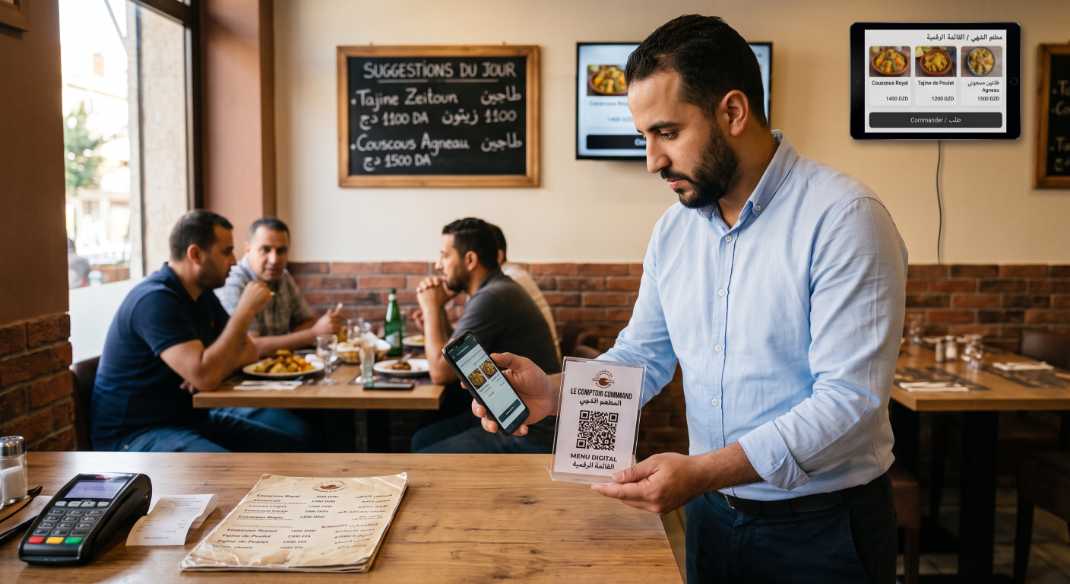
This comparison does not measure how good the software is. It measures what each vendor makes publicly verifiable — the only information a restaurateur has before picking up the phone. Twenty-two names checked, fourteen scored. The main ranking rests on a functional score computed with the same formula for all fourteen; price is scored separately. This is a multidimensional score: a high total does not mean a complete ordering flow. Only three vendors document all five components of that flow, and only one describes a SATIM integration. NResto ranks first on verifiable features, ahead of Milimenu and BorneDZ.
- TL;DR
- Introduction
- Scope and inclusion rule
- Method
- The four solutions furthest along on documented ordering
- The others
- International benchmark, outside the ranking
- Ordering-flow matrix
- Anchoring and independence matrix
- Main ranking: functional score
- Price score and combined score
- Recommendations by use case
- Currency and payment
- Outlook: three scenarios for 2027-2028
- FAQ
- Why has the ranking changed?
- Is a QR code menu in Algeria expensive?
- Do you need a different code for each table?
- How do you check a vendor is still active?
- What happens if your vendor shuts down?
- Conclusion
Introduction
In August 2026, a restaurateur in Algiers, Oran or Sétif searching for a QR code menu in Algeria lands on twenty-odd near-interchangeable homepages. Same promise, same vocabulary, and no public grid to tell them apart. The industry myth holds that these solutions are equivalent; checking them contradicts it, because the gap between a reading device and a sales channel is considerable. What is at stake is the architecture of the customer relationship, as shown in our analysis of delivery unit economics.
Scope and inclusion rule
Twenty-two names checked on 28 August 2026. A solution is included if it meets at least one of three objective criteria: the vendor is established in Algeria; the offer is explicitly sold in Algeria, through dinar pricing or a stated target market; or there is a public, verifiable Algerian deployment. Seven names are excluded on four grounds.
- Out of category (1) — Symloop: software engineering and deep tech, with no QR menu offering.
- Unreachable domain (3) — mytable.dz, order24.dz, iresto.dz.
- Service unavailable (1) — restausoft.com: 503 error.
- Insufficient public data (2) — Omnimenu, Menyoo: live domains, no documented Algerian offering.
Fifteen solutions remain, fourteen of them scored. Clyo Systems meets none of the three inclusion criteria and appears as an international benchmark, outside the ranking. Feady’s is kept: its site explicitly targets Algiers.
Ressource recommandée
Executive Discipline System — le template Notion des fondateurs lucides
Un système opérationnel conçu pour structurer la discipline quotidienne,
clarifier les priorités et maintenir une exécution constante dans des contextes
de forte pression.
Pensé pour les fondateurs, dirigeants et profils exécutifs — pas pour la motivation,
mais pour la tenue dans la durée.
Method
Standard of proof. Any public information a reader can see counts, whatever its format: vendor pages, pricing, documentation, screenshots, live customer menus. A price shown in an image counts as much as a price shown in text. Vendor claims that are not published are never scored. Three states apply: described when the source shows the function working (full points), mentioned when it is named without description (half points), and not documented when it is absent from the sources consulted (zero). The marker not collected flags public information this audit could not read: a gap on the auditor’s side, not the vendor’s, and it produces a score range rather than a single value.
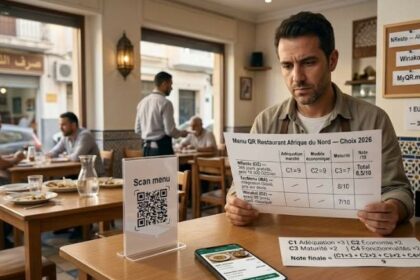
Functional score. Three criteria. C1, table-ordering flow (weight 3): five components worth 2 points each — order confirmed from the table, automatic table identification, variants and add-ons, receipt on a dedicated station, and out-of-stock handling. C2, Algerian operational anchoring (weight 2): four variables worth 2.5 points each — dinar billing, Arabic interface, local electronic payment offered to the end customer, and documented local support. C4, commercial independence (weight 2): three sub-criteria averaged — commission (10 if its absence is published, or if no transactional flow exists to take one from; 0 if a commission is announced or nothing is documented); directory inside the product (10 if no public directory was identified during the audit, 5 if peripheral, 0 if a central marketplace); and own brand or domain (10 if verified, 0 otherwise). Formula: (C1×3 + C2×2 + C4×2) / 7, rounded to the nearest half point. The formula is identical for all fourteen; completeness levels are reported separately.
Price score, kept separate. C3 measures the three-year total cost of ownership of the cheapest tier that unlocks the features credited in C1, even when they are only sold inside a wider bundle. A three-year horizon puts subscriptions and perpetual licences on the same footing. Conversion at 145 DZD to 1 euro. The scale is linear, anchored on the highest TCO in the panel as of 28 August 2026, 207,000 DZD: C3 = 10 − 5 × (TCO ÷ 207,000). Giving 5 rather than 0 to the most expensive product remains an editorial decision, and the scale is relative to this dated panel. Gross prices appear next to the score for anyone who prefers to compare amounts directly.
What the score does not say. A zero means “not publicly documented”, never “the feature does not exist”. Three dimensions are not covered: customer data export, the vendor’s right to reuse that data, and the depth of the upsell journey. The first two are documented by none of the fourteen; the third was deliberately not added mid-audit, because introducing a criterion after seeing the results would mean building the grid around the ranking.
The four solutions furthest along on documented ordering
NResto — 9.5 functional, 12/12 fields filled. All five flow components are verifiable on the homepage: customer confirmation, “each table has its own QR code”, variants and add-ons, receipt on FelHanout Pro, and switching off a dish that has run out. No private claim feeds this score. On a live table menu, the interface exists in Arabic with full right-to-left rendering, and one customer restaurant serves the same menu on its own domain, pizza447.com. Pricing: 6,500 DZD per quarter for the menu alone, 40,000 DZD a year for menu plus delivery. Documented limits: no POS, no kitchen display, no electronic payment for the end customer. Its dependence on the FelHanout ecosystem, documented in our post-mortem of its foodtech pivot, remains a concentration risk.
Milimenu — 8.5 functional, 12/12. Its public documentation describes all five components: “every table in your room gets its own QR code”, ingredients customers can uncheck, add-ons recalculated server-side, a real-time order board built for the kitchen, and one-click suspension of a dish that has run out. Arabic interface, dinar billing, payment through Chargily, 0% commission, entry price 2,500 DZD per month. Electronic payment for the end customer is listed but never described. No own domain documented.
BorneDZ — 8.5 functional, 12/12. The widest public feature set in the panel: kiosk, POS, kitchen display, online ordering, table QR, courier tracking, offline mode, right-to-left Arabic interface, and white-label own domain. It is the only vendor describing a SATIM integration with server-side verification for CIB and Edahabia, according to the vendor; no actual payment was tested here. The only missing piece in its documented flow is the per-table code. The vendor calls itself “the only player on the market that displays its prices”, which is inaccurate: five competitors publish theirs. Its “Where to order” map amounts to a peripheral directory.
Feady’s — 7.0 functional, 12/12. Fifth overall despite a fully documented flow: unique QR per table with anti-remote-ordering safeguards, product options, receipt with table number, out-of-stock alerts, custom domain, 0% commission. C3 uses the Pro plan at 150 euros a year, the only tier whose public pricing quantifies a table-order allowance. And a C2 of zero: euros, Stripe and PayPal collection, Moroccan support, French-only app.
The others
Qresto (7.5 functional, 12/12) ranks fourth despite a partial flow: its total comes from anchoring and independence, not from ordering. Published by Nexeo, it documents QR codes per table or zone, live hiding of a sold-out product, themes in French, Arabic and English with RTL support, waiter and bill requests, and a console where those requests stay visible until handled. Ordering from the table is not a product function: the vendor states that “Qresto does not touch your POS” and only mentions notified orders in the Signature pack, without describing the flow. No directory, own domain documented in the chain tier, and no commission applicable to the current flow. Packs at 2,000, 3,000 and 4,200 DZD per month; C3 uses Signature, the only tier containing the notified ordering that earns its half points.
RestoSmart (5.0 functional, 12/12) claims more than a hundred restaurants equipped in Algeria and displays a wall of references. Its FAQ describes ordering from the table without staff involvement, with tickets arriving at the point of sale and in the kitchen; the interface exists in French, English and Arabic, and pricing is in dinars. No per-table code, variants or out-of-stock handling documented. Its distinctive trait is the model: a perpetual licence from 49,000 DZD, with no subscription or annual fees, unique in this panel — which gives it the best three-year price score. The back-office screenshot published on its site shows an Odoo interface; it is worth asking in writing what exactly the licence covers regarding hosting, maintenance and updates.
Chez les athlètes de haut niveau, la discipline n’est pas une question de motivation. C’est un système : des routines, des séquences, un cadre auquel on revient quand la pression monte et que le chaos s’installe.
L’Executive Discipline System applique cette logique au quotidien des fondateurs et dirigeants : structurer l’exécution, maintenir la clarté mentale, et continuer à avancer même après un “match perdu”.
Voir le système →Restolink (3.5 to 4.0, ranked 7th or 8th) bundles eight services under a single annual subscription, with manager, cashier, waiter and cook accounts, and states it charges no commission; the table flow is not documented and its pricing, published as images, could not be collected. Menumax (3.5), published by FREQUENCY out of Sétif, describes QR orders arriving at the POS for validation, ten connected printers and order-number calling on Android TV; no pricing published.
Infinity Tag (3.5) and Menubarcode DZ (2.5) both show amounts without a billing period — 2,500 and 4,500 DZD for the former, 1,500 and 3,500 for the latter — and document no ordering flow. Miamm’s (3.5), one of the oldest players, shows a dinar cart, a pricing page and a bundled Google reviews option, and serves live customer menus in Algiers and Biskra; pricing not collected. Quiikly (3.0) offers a free plan capped at three scans a month and an Extra plan at 30,000 DZD a year, with ordering listed but never described and an Arabic interface available.
Winakol (1.5) pairs a QR menu with a directory — fourteen venues were visible in it during the check — and advertised 90 free days and fifteen free days at the same time. TableBeep (1.5) combines a QR menu with a discovery marketplace across Algiers and Oran, with trending rankings, no documented ordering flow and no pricing; the architecture shifts part of the discovery relationship onto a third-party platform, which overlaps with the debate on the paid model versus the advertising model.
Three families under a single label. It is a hardware shop selling a screwdriver, a power drill and a full workshop under the same “tools” sign: three products, three different problems, and a distinction rarely spelled out in the sales material.
International benchmark, outside the ranking
Clyo Systems, a French POS software vendor, meets none of the three inclusion criteria: no dinars, no Arabic, no local payment, no documented Algerian support. It appears here as a reference point, because its QR module documents all five flow components — a table-ordering QR that opens the menu with the table number already registered, composed menus and garnishes, orders landing on the POS and production screen, and automatic removal of a dish that has run out in the kitchen — with no commission and full white labelling. Applied for illustration only, the scale would give it 7.0, exactly Feady’s score: two foreign products with a complete flow and no local anchoring land at the same point on the grid.
Ordering-flow matrix
D = described (2 pts) · M = mentioned (1 pt) · — = not documented (0 pts)
| Solution | Order from table | Per-table code | Variants | Receipt station | Out-of-stock | C1 /10 |
|---|---|---|---|---|---|---|
| NResto | D | D | D | D | D | 10 |
| Milimenu | D | D | D | D | D | 10 |
| Feady’s | D | D | D | D | D | 10 |
| BorneDZ | D | — | D | D | D | 8 |
| Qresto | M | D | — | M | D | 6 |
| RestoSmart | D | — | — | D | — | 4 |
| Menumax | D | — | — | D | — | 4 |
| Restolink | — | — | — | D | — | 2 |
| Quiikly | M | — | — | — | — | 1 |
| Menubarcode DZ | M | — | — | — | — | 1 |
| Winakol | M | — | — | — | — | 1 |
| Infinity Tag | — | — | — | — | — | 0 |
| Miamm’s | — | — | — | — | — | 0 |
| TableBeep | — | — | — | — | — | 0 |
Anchoring and independence matrix
NC = public information not collected during the audit, hence a range.
| Solution | Dinars | Arabic | Local payment | Local support | C2 /10 | Commission | Directory | Domain | C4 /10 |
|---|---|---|---|---|---|---|---|---|---|
| BorneDZ | D | D | D | D | 10.0 | 10 | 5 | 10 | 8.33 |
| Milimenu | D | D | M | D | 8.75 | 10 | 10 | 0 | 6.67 |
| NResto | D | D | — | D | 7.5 | 10 | 10 | 10 | 10.0 |
| Qresto | D | D | — | D | 7.5 | 10 | 10 | 10 | 10.0 |
| RestoSmart | D | D | — | D | 7.5 | 0 | 10 | 0 | 3.33 |
| Infinity Tag | D | M | — | D | 6.25 | 10 | 10 | 0 | 6.67 |
| Quiikly | D | D | — | M | 6.25 | 0 | 10 | 0 | 3.33 |
| Miamm’s | D | — | — | D | 5.0 | 10 | 10 | 0 | 6.67 |
| Menubarcode DZ | D | — | M | — | 3.75 | 0 | 10 | 0 | 3.33 |
| Winakol | — | D | — | M | 3.75 | 0 | 0 | 0 | 0.0 |
| Restolink | NC | — | — | D | 2.5 – 5.0 | 10 | 10 | 0 | 6.67 |
| Menumax | — | — | — | D | 2.5 | 0 | 10 | 0 | 3.33 |
| TableBeep | — | — | — | M | 1.25 | 10 | 0 | 0 | 3.33 |
| Feady’s | — | — | — | — | 0.0 | 10 | 10 | 10 | 10.0 |
Main ranking: functional score
| Rank | Solution | C1 | C2 | C4 | Score /10 | Fields filled |
|---|---|---|---|---|---|---|
| 1 | NResto | 10 | 7.5 | 10.0 | 9.5 | 12/12 |
| 2 | Milimenu | 10 | 8.75 | 6.67 | 8.5 | 12/12 |
| 2 | BorneDZ | 8 | 10.0 | 8.33 | 8.5 | 12/12 |
| 4 | Qresto | 6 | 7.5 | 10.0 | 7.5 | 12/12 |
| 5 | Feady’s | 10 | 0.0 | 10.0 | 7.0 | 12/12 |
| 6 | RestoSmart | 4 | 7.5 | 3.33 | 5.0 | 12/12 |
| 7–8 | Restolink | 2 | 2.5 – 5.0 | 6.67 | 3.5 – 4.0 | 11/12 |
| 7–8 | Infinity Tag | 0 | 6.25 | 6.67 | 3.5 | 12/12 |
| 9 | Menumax | 4 | 2.5 | 3.33 | 3.5 | 12/12 |
| 10 | Miamm’s | 0 | 5.0 | 6.67 | 3.5 | 12/12 |
| 11 | Quiikly | 1 | 6.25 | 3.33 | 3.0 | 12/12 |
| 12 | Menubarcode DZ | 1 | 3.75 | 3.33 | 2.5 | 12/12 |
| 13 | Winakol | 1 | 3.75 | 0.0 | 1.5 | 12/12 |
| 14 | TableBeep | 0 | 1.25 | 3.33 | 1.5 | 12/12 |
Restolink’s rank stays undetermined between 7th and 8th until its pricing grid, published as images, has been collected. Seven of the fourteen have no computable TCO: no public price at Menumax, Winakol and TableBeep; an amount without a billing period at Menubarcode DZ and Infinity Tag; a published but uncollected price at Restolink and Miamm’s. The first two situations stem from what the vendor publishes, the third from a limit of this work.
Price score and combined score
| Solution | Tier used | 3-year TCO | C3 /10 | Combined score |
|---|---|---|---|---|
| RestoSmart | Perpetual licence | 49,000 DZD | 8.82 | 5.5 |
| Feady’s | Pro plan, 150 €/yr | 65,250 DZD | 8.42 | 7.5 |
| Milimenu | Annual offer | 75,000 DZD | 8.19 | 8.5 |
| NResto | Menu only | 50,000 DZD | 8.52 | 9.0 |
| Quiikly | Extra plan | 90,000 DZD | 7.83 | 4.0 |
| Qresto | Signature pack | 151,200 DZD | 6.35 | 7.5 |
| BorneDZ | Complete offer | 207,000 DZD | 5.00 | 8.0 |
The TCO uses the published price of the cheapest tier that unlocks the features credited in C1, with no reconstruction: NResto does not publish an annual rate for the menu alone, only 6,500 DZD per quarter, and its 40,000 DZD annual package includes delivery, which does not serve any point in C1. The same principle applies to BorneDZ, whose table QR is only sold within a 69,000 DZD per year offer.
Recommendations by use case
Editorial recommendations, not recomputed. Table ordering documented end to end: NResto, Milimenu, and Feady’s subject to the currency question. Integrated POS and kitchen display: BorneDZ, RestoSmart, Restolink, Menumax. Menu browsing and in-room interactions, with ordering only mentioned in the top tier: Qresto. Replacing paper at minimum cost: Menubarcode DZ, Infinity Tag, Miamm’s. If electronic customer payment is your first criterion, BorneDZ is the option whose local integration is best documented, and the top-ranked solution drops off your list.
Currency and payment
An Algerian restaurateur subscribing to Feady’s Pro plan pays 150 euros a year. That assumes access to foreign currency and an international payment method, then collection through Stripe or PayPal, whose access conditions for an Algerian merchant are to be checked with those platforms rather than with the menu vendor. The issue reaches into the structure of exchange controls, which we have shown conditions the emergence of Algerian venture capital and helps explain the francophone paradox documented by Partech. Editorial inference: local anchoring — currency, language, payment, support — can weigh heavily in actual use. Feady’s illustrates it: maximum flow, zero anchoring, fifth in the functional ranking.
Electronic customer payment remains a differentiator without being the main technical divide. One vendor describes the mechanism, two mention it; for the other eleven, no payment integrated into the flow is documented, which is not enough to conclude that they take cash only. It is one of the open fronts for Algerian startups to watch in 2026.
Outlook: three scenarios for 2027-2028
Consolidation through the POS. Operating suites absorb simple menus and the QR menu becomes a free feature bundled with a paid POS. That shift requires three conditions: an annual budget of 60,000 to 70,000 DZD accepted by independent fast-food operators, a distribution network able to install and train on site, and migration costs low enough to justify switching tools mid-operation. The last is the least certain: a menu already entered, QR codes already printed and a team already trained create friction that vendors underestimate.
Marketplace tipping point. TableBeep, Winakol or a funded entrant turn their directory into a commission-based discovery platform. The QR menu becomes a free lead product and monetisation shifts to paid placement — the mechanism described in our last-mile delivery analysis. This scenario requires enough restaurant density for discovery to carry value, and patient capital able to fund several years of free service; the directories observed remain thin in the public data consulted.
Lasting fragmentation. Nothing tips. Fourteen vendors coexist without any reaching critical mass, prices stay low and innovation stays incremental. That is what we observe today, and it is the most underestimated scenario: the absence of consolidation may not be a passing anomaly but the equilibrium of a market where building a QR menu costs almost nothing. The most decisive factor remains card adoption in the dining room: if cards become the dominant payment method in quick service, the advantage swings to vendors integrated with SATIM and the first scenario gains ground — without prevailing, because support quality and integration with installed POS systems will weigh just as much.
FAQ
Why has the ranking changed?
The standard of proof was harmonised first: features NResto described outside its public pages were removed, which pushed it down. New public evidence was then taken in — Arabic interface, own domain in production — which brought it back up. The matrices contain every sub-score.
Is a QR code menu in Algeria expensive?
Published amounts run from 1,500 DZD, sometimes without a stated billing period, to 69,000 DZD a year for a full suite, plus one perpetual licence at 49,000 DZD. The spread reflects scope, not quality. Seven of the fourteen have no three-year cost computable in this audit.
Do you need a different code for each table?
It matters as soon as you accept orders from the table: without automatic identification, the customer types their own table number and mistakes become likely at peak hours. Four vendors document this feature. For simple menu browsing, one code per venue is enough.
How do you check a vendor is still active?
Test the domain, ask for a demo in real conditions, insist on a reachable customer reference and read the termination terms. On 28 August 2026, three domains did not respond, one returned a server error, and two footers still showed 2024 or 2025.
What happens if your vendor shuts down?
Risks may include losing access to the menu, invalidation of hosted QR codes and unavailability of order history; how bad it gets depends on the architecture, domain ownership and export capability. Ask in writing before signing: data export, URL ownership, backups, reversibility, and the vendor’s right to reuse your customer data. None of the fourteen documents that last point publicly.
Conclusion
The QR code menu market in Algeria is not a market of features but of mislabelled categories. Twenty-two names checked, fourteen scored, three different trades, one confusion.
NResto ranks first on publicly verifiable features, with a declared conflict of interest and twelve of twelve fields filled. Its position rests on four points anyone can check: a complete ordering flow, a trilingual interface with full RTL support for Arabic, an own domain in production, and a low entry price. It does not rest on electronic payment, which the vendor does not document, nor on a POS, which it does not have. Milimenu and BorneDZ follow one point behind, one on local anchoring, the other on payment. The only ranking that matters is the one you rebuild from your own constraints and the scale above — not this article, nor any other published in our foodtech section.
Which leaves the question to settle before comparing anything at all: does your restaurant need a menu, an ordering channel, or a genuine operating system?
Methodological note — Twenty-two names checked on 28 August 2026; seven excluded, fourteen scored, one placed in an international benchmark for failing the inclusion rule. The scale published in the Method section is applied to publicly readable sources whatever their format; unpublished vendor claims are not scored, including for NResto. The “not collected” marker flags a gap in this audit, to be corrected once collected, for Restolink and Miamm’s pricing. The ranking has been revised four times: harmonising the standard of proof, taking in new public evidence, separating the functional score from the price score, then widening the scope to Qresto and RestoSmart, two offerings an earlier audit had missed. Any vendor who makes publicly verifiable a feature currently scored “not documented” will have its score revised on the same scale. Further analysis on the Algerian ecosystem, SaaS and the North African QR menu landscape.