
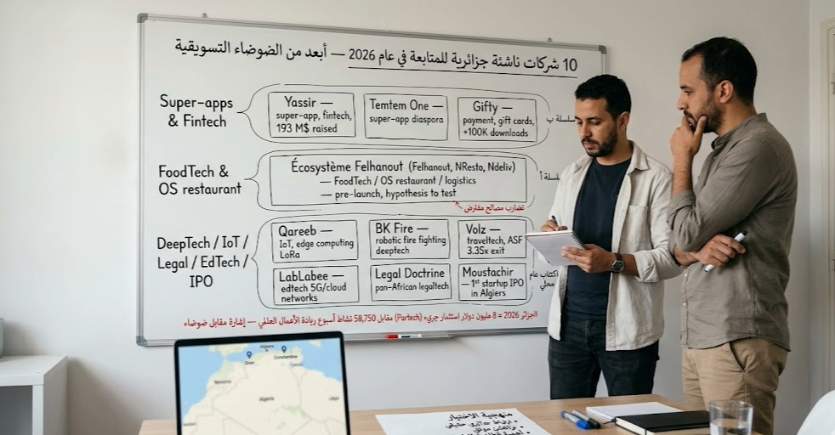
TL;DR: An analytical reading of ten young companies that deserve serious attention in 2026, from super-apps worth hundreds of millions of dollars to pre-launch ventures reinventing local FoodTech. Yassir, Temtem One, Gifty, the Felhanout ecosystem (including NResto and Ndeliv), Qareeb, BK Fire, Volz, LabLabee, Legal Doctrine, and Moustachir form a map of the Algerian ecosystem — its strengths, its blind spots, and its possible tipping points by 2030.
- Methodology: how these ten Algerian startups were selected
- Macro snapshot: where does the Algerian ecosystem stand in early 2026?
- Category 1 — Super-apps and fintech: who is actually changing daily life?
- Category 2 — FoodTech: the Felhanout, NResto, and Ndeliv ecosystem in a single read
- Category 3 — DeepTech, IoT, and industry: the less visible building blocks shaping the future
- Comparative table: the 10 startups at a glance
- Outlook 2026–2030: how many of these ten Algerian startups will still be in the game?
- FAQ: the questions I always get about Algerian startups
- How does this list differ from StartupBlink rankings or classic media lists?
- Does this list automatically mean the best-funded?
- How can an investor or founder concretely “follow” these ten companies?
- What role does the Algerian state and the ASF play in these projects’ viability?
- Does the list focus solely on Algeria, or does it include companies operating outside the country?
- Will the list change by 2027?
- What if my startup deserves to be on the list but isn’t?
- Conclusion: what this list really says about Algeria in 2026
Conflict of interest disclosure: MagStartup and the Felhanout / NResto / Ndeliv ecosystem share direct founding ties. Their inclusion in this selection is therefore not neutral. It is acknowledged for editorial reasons (Algerian FoodTech deserves to be dissected), governed by the same methodological filter applied to all other entries, and flagged at each mention. The numbering from 1 to 10 is thematic, not hierarchical.
January 2026. The Partech Africa report publishes its figures: roughly eight million dollars in equity captured by Algeria over the year — approximately forty-five times less than Egypt. That same month, the Ministry of the Knowledge Economy celebrates the 58,750 activities claimed during GEW 2025. Two narratives, two Algerias. And between them, a question that persists: if one were to name today the ten young companies that truly deserve to be followed in this country, who would make the list — and by what criteria? Existing lists are scarce, scattered, and often devoid of explicit methodology.
There lies the problem. The dominant narrative oscillates between two comfortable myths. On one side, the idea that “Algeria has nothing to show” — a lazy take that the numbers have been contradicting for years. On the other, the uncritical celebration of an ecosystem “exploding,” fueled by political scorecards like the 58,750 activities claimed during GEW 2025. Between the two, a more useful reality: a core group of young companies generating revenue, signing contracts, raising capital.
Ressource recommandée
Executive Discipline System — le template Notion des fondateurs lucides
Un système opérationnel conçu pour structurer la discipline quotidienne,
clarifier les priorités et maintenir une exécution constante dans des contextes
de forte pression.
Pensé pour les fondateurs, dirigeants et profils exécutifs — pas pour la motivation,
mais pour la tenue dans la durée.
After combing through StartupBlink rankings, Crunchbase profiles, and official press releases, the gap between media noise and real signal becomes obvious. This article does not claim to produce a definitive ranking: it offers a reasoned selection of ten young companies that any serious founder, investor, or journalist should be watching in 2026 — and above all, why.
Methodology: how these ten Algerian startups were selected
Before the names, the criteria. A list without methodology is nothing more than a public relations exercise. Here is the framework applied, openly.
First filter: genuine Algerian roots. Core team, primary market, or significant operations in Algeria. Offshore holdings do not disqualify — MagStartup’s analysis of Francophone capital flows showed that a share of scalable Algerian ventures structure a Delaware or French holding for convertibility reasons.
Second filter: documented traction. Either revenue, a verifiable user count, a closed funding round, or a signed institutional partnership. The selection deliberately includes two or three pre-launch editorial bets, flagged as such.
Third filter: sectoral relevance. Multiple verticals covered: super-apps, fintech, FoodTech, traveltech, legaltech, edtech, IoT, industrial deeptech. Primary sources cross-referenced: StartupBlink Algeria 2025, ZoomAlgérie, AlgeriaTech.news, and MagStartup’s Algeria coverage.
Macro snapshot: where does the Algerian ecosystem stand in early 2026?
Before the trees, the forest. Algeria ranks 111th globally and 4th in North Africa according to StartupBlink 2025, with 7.2% growth over the year. On startup.dz, over 7,800 entities are registered and roughly 2,300 have obtained the official label — a 29% conversion rate.
On the capital side, the picture is more sober. The Partech Africa 2025 report records 8 million dollars in equity and 4 deals for Algeria over the year — roughly 45 times less than Egypt. This is what MagStartup calls the Algerian paradox: massive institutional mobilization on one side, an embarrassing statistical anomaly on the other. Partly a measurement artifact (offshore holdings escape the “HQ Algeria” filter), but one that does not disappear regardless.
And yet, the mood is shifting. The Algerian AI market is projected to reach $1.69 billion by 2030, up from $498.9 million in 2025, representing a CAGR of roughly 27.7% according to AlgeriaTech.news. The silent crisis of African Seed+ funding weighs on Algeria too, without killing the local momentum. Founders keep pushing forward, often bootstrapped, rarely with VC tickets exceeding one million dollars.
Category 1 — Super-apps and fintech: who is actually changing daily life?
In this context, the ten names selected stand out along three observable patterns: a heavily capitalized heavyweight serving as proof-of-concept (Yassir), a middle layer of confirmed Series A companies holding their trajectory (Temtem, Volz, LabLabee), and a long tail of bootstraps and pre-launches that carry little capital weight but significant market signal. Three names dominate this first category, and none is truly interchangeable.
1. Yassir — the heavyweight. Founded in 2017 in Algiers by Noureddine Tayebi, Yassir has raised approximately $193 million cumulatively, including a $150 million Series B led by BOND in November 2022, according to its Crunchbase profile. Estimated valuation around $600 million, 8 million claimed users, declared presence in 45 cities. As detailed in MagStartup’s long-form analysis, the startup turned the absence of Algerian banking rails into a defensive moat via Yassir Money. To our knowledge, this is the most advanced post-Series B trajectory of any young company of Algerian origin to date. 2026 fragility: the fallout from Yassir France’s judicial liquidation in late 2025, and the pressure of a potential Series C in a degraded VC climate.
Chez les athlètes de haut niveau, la discipline n’est pas une question de motivation. C’est un système : des routines, des séquences, un cadre auquel on revient quand la pression monte et que le chaos s’installe.
L’Executive Discipline System applique cette logique au quotidien des fondateurs et dirigeants : structurer l’exécution, maintenir la clarté mentale, et continuer à avancer même après un “match perdu”.
Voir le système →2. Temtem One — the diaspora super-app. Founded in 2017 by Kamel Haddar (ESCP Europe), Temtem started in mobility before pivoting to a multi-service super-app: transport, delivery, home healthcare, home repair, shopping, and a diaspora channel. According to WeAreTech Africa, approximately $5.7 million raised cumulatively, including a $4 million Series A in 2019 by Tell Venture Automotive — confirmed by Jeune Afrique. Partnerships with Decathlon, Puma, Huawei, Ooredoo. Kamel Haddar sums it up: “improve people’s lives by making the services that matter more easily accessible.” 2026 angle: effective monetization of the diaspora channel.
3. Gifty — the multi-service fintech bypassing banking rails. Founded in 2023 by Abderrahmane Anemiche, Gifty allows users to pay bills (Sonelgaz, SEAAL, internet), top up mobile credit, subscribe to services (Netflix, Spotify), and purchase multi-brand gift cards from a rechargeable wallet via CIB card, EDahabia, or a physical network of connected convenience stores. According to WeAreTech Africa, the app claims over 100,000 downloads on Google Play and a network of approximately 18,000 partner points of sale (company-declared figure, unaudited). Anemiche told Forbes Afrique in October 2025: “my goal was clear: tackle the structural cash problem head-on.” 2026 angle: transforming the wallet into an everyday payment tool.
Category 2 — FoodTech: the Felhanout, NResto, and Ndeliv ecosystem in a single read
FoodTech is one of the most sensitive categories in the Algerian landscape in 2026. Yassir operates its delivery arm with a 15% commission and a classic aggregator model. But a different approach is emerging in parallel, built around Ahmed Fatmi and his integrated Felhanout / NResto / Ndeliv ecosystem.
4. The Felhanout ecosystem — three architectures, one operator. Founded by Ahmed Fatmi on a budget of $120,000 invested since October 2023. Felhanout: a three-layer hybrid SaaS with no direct commission, monetizing by taking three percentage points from the discount rate activated by the restaurant — the inverse of the 30% aggregator commission model. Launch on April 1, 2026, with 90 announced partner restaurants. NResto: a free QR menu monetized through contextual advertising (see the MagStartup report). Ndeliv: the announced logistics layer, still at the intention stage. Overall proof level: zero active restaurants. See MagStartup’s pre-launch analysis. To be considered as an architectural hypothesis, not a validated player.
Category 3 — DeepTech, IoT, and industry: the less visible building blocks shaping the future
5. Qareeb — IoT and edge computing made in Algeria. Founded in 2023 by Adam Debba (ENP Algiers, PhD from IMT Atlantique, ex-Capgemini Engineering), Qareeb designs AI solutions that operate locally without transferring data to remote servers. Its flagship product Q-Farming reportedly uses, according to WeAreTech Africa, LoRa technology to transmit agricultural data up to 30 km without mobile coverage (company-declared range). The startup also offers Q-Vision (surveillance) and Q-Access (access control). In 2024, Adam Debba won the Greentech Challenge at the Algeria Startup Challenge and represented Algeria at LEAP 2025 in Riyadh. Known traction: documented pilots within SETRAM (Algeria’s tramway operator), international awards, but no public revenue data.
6. BK Fire — the deeptech industrial SME in fire safety. Let’s be upfront: BK Fire is not a startup in the strict sense. Established in 2008 under the name IM Industrielle and later repositioned as BK Fire, it is an Algerian industrial SME that has become relevant through its deeptech pivot. The company manufactures pumping stations, NF LPCB-certified fire hose reels, and detection systems. But it is primarily its Icosium robot that justifies its inclusion: a remotely-operated firefighting robot equipped with 4K cameras and a water jet propulsion system resistant, according to the company, to temperatures reaching 2,000°C — positioned, again according to BK Fire, as the first robot of its kind manufactured in Africa (a claim not verified by an independent third-party source). Known traction: existing physical product, presence at specialized trade shows, probable institutional contracts in the ERP and industrial sectors, but no public financial data on Icosium. 2026 angle: adding an AI layer to automate detection and intervention.
7. Volz — the traveltech shaking up the ASF. Founded in 2022 by Mohamed Abdelhadi Mezi, Volz became in December 2025 the first successful exit from the Algerian Startup Fund, with a reported 3.35× return. Volz raised approximately 600 million DZD (≈ $5M in Series A). As detailed in MagStartup’s Volz Algeria 2026 analysis, the unicorn ambition remains distant when you stress-test the assumptions, but the friction addressed is real.
8. LabLabee — the deeptech edtech. Specializing in virtual labs for 5G network technologies, cloud, and AI, LabLabee enables engineering students, telecom technicians, and corporate teams to learn network infrastructure hands-on without expensive physical equipment. The startup raised $3.4 million in seed funding in 2024 from international edtech-specialized funds. Target clientele: telecom operators, integrators, engineering schools, corporate trainers. Key differentiator: expertise in low-level network layers (5G, virtualization), often absent from generalist edtech platforms. 2026 fragility: long B2B sales cycles and competition from better-funded US/European platforms on the segment.
9. Legal Doctrine — the pan-African legaltech. Based in Algiers, Legal Doctrine provides a platform for accessing legislation, regulations, and case law, with expansion announced to 12 African countries according to its own communications. Target clientele: lawyers, corporate counsel, compliance departments, international firms operating in Francophone Africa. Differentiator: aggregation and structuring of fragmented legal data, in a region where access to positive law remains a major friction point for foreign investors. 2026 fragility: the ability to execute across multiple jurisdictions, requiring local partnerships in each target country and considerable editorial work.
10. Moustachir — the first startup IPO in Algiers. An electronic consulting platform, Moustachir became in early 2025 the first startup listed on the Algiers Stock Exchange, with an IPO oversubscribed by 119% and approximately 94 million DZD raised. Modest in size. Symbolically decisive: it proves that a local exit pathway exists, in a country where the absence of credible exit mechanisms remains a major barrier.
Honorable mentions outside the top: Banxy (mobile neobank, Natixis), FarmAI (AI agritech), Opticharge (B2B logistics), Fatoura by Brainiac (SaaS billing), Zawwali (e-commerce).
Comparative table: the 10 startups at a glance
| Startup | Vertical | Stage / Capital | Differentiating signal | 2026 fragility |
|---|---|---|---|---|
| Yassir | Super-app, fintech | Series B, ~$193M | Most advanced post-Series B trajectory to our knowledge | Yassir France liquidation, degraded VC climate |
| Temtem One | Super-app, diaspora | Series A, ~$5.7M | Rare diaspora positioning in the Maghreb | Head-on competition with Yassir |
| Gifty | Fintech, payments, gift cards | Funding undisclosed, +100K claimed downloads | Network of 18,000 partner points of sale | Competition from official banking wallets |
| Felhanout Ecosystem (Felhanout + NResto + Ndeliv) | FoodTech, OS platform, ad-tech, logistics | Bootstrap, $120K | Integrated commission-free architecture | Post-launch execution risk, capital-constrained |
| Qareeb | IoT, edge computing, agritech | Greentech Challenge winner, LEAP 2025 presence | Edge computing LoRa 30 km off-coverage | Long B2B sales cycles, limited capital |
| BK Fire | DeepTech, robotics, fire safety | Industrial deeptech SME, not a startup strictly | Firefighting robot presented as an African first | No public financial data |
| Volz | TravelTech | Series A, ~$5M | First ASF exit (3.35×) | Fragile LTV:CAC, contested unicorn ambition |
| LabLabee | EdTech deeptech | Seed, $3.4M | International telecom contracts | Long B2B sales cycle |
| Legal Doctrine | LegalTech | Early-stage | Announced expansion to 12 African countries | Multi-jurisdictional execution capacity |
| Moustachir | SaaS consulting | IPO on Algiers Stock Exchange | First startup listing in Algiers | Near-zero secondary liquidity |
Outlook 2026–2030: how many of these ten Algerian startups will still be in the game?
The following scenarios are editorial estimates, not quantified predictions. They draw on dynamics observed in Partech reports, MagStartup analyses, and comparable African benchmarks.
Optimistic scenario (estimated probability: 20–25%). Yassir closes a Series C around the billion-dollar valuation mark and becomes North Africa’s first unicorn. Volz attracts regional funds and reaches $15–20 million in annual revenue. Gifty and Qareeb sign their first structuring corporate contracts. Three or four names on this list become credible regional leaders by 2030.
Central scenario (estimated probability: 50–55%). Yassir remains an isolated case but does not deteriorate. Temtem One and Gifty stabilize their traction without hyper-growth. Volz holds the trajectory of a profitable tech SME at around $5–8 million in revenue. Felhanout validates its flywheel in Algiers with 200–400 restaurants in year one. NResto remains at the pilot stage, Ndeliv emerges in beta. Qareeb and BK Fire sign their first significant B2B contracts. Two or three names disappear or pivot. The ecosystem progresses but remains far behind Tunisia, Morocco, and Egypt in deployed capital.
Pessimistic scenario (estimated probability: 25–30%). The African Seed+ crisis worsens. Yassir fails to close its Series C on desired terms and proceeds with cuts. The pre-launch FoodTech bets fail to reach profitability before capital runs out. Volz remains confined to a local niche. The majority of other names enter survival mode. Brain drain accelerates: several founders migrate to Paris, Dubai, or Casablanca. The Pre-Series A phase becomes a silent graveyard. By 2030, the 2026 list resembles a memento mori of the Algerian ecosystem.
The real question is therefore not who are the best companies in 2026. It is: how many of them will manage to turn their market intuition into a sustainable business model by 2030?
FAQ: the questions I always get about Algerian startups
How does this list differ from StartupBlink rankings or classic media lists?
StartupBlink rankings rely heavily on quantitative signals (capital raised, employees, web traffic) and mechanically favor already-visible players. This selection adds a qualitative layer: model relevance, angle originality, ability to represent an entire vertical. This is why certain pre-launch bets are included, but flagged as such in the body of the text.
Does this list automatically mean the best-funded?
No, and this is an important point. Capital is a metric, not the metric. Felhanout operates with $120,000 where Yassir has raised $193 million. Both deserve to be followed — for radically different reasons. Confusing top startup with top valuation is like confusing a runner’s height with the quality of their race.
How can an investor or founder concretely “follow” these ten companies?
Three practical channels: their official websites and product pages, their founders’ LinkedIn profiles (Noureddine Tayebi for Yassir, Kamel Haddar for Temtem, Abderrahmane Anemiche for Gifty, Ahmed Fatmi for the Felhanout ecosystem, Adam Debba for Qareeb, Mohamed Abdelhadi Mezi for Volz), and ongoing sectoral monitoring via MagStartup’s Algeria coverage. For B2B contacts, going through open innovation programs or public pitches remains more effective than cold emails.
What role does the Algerian state and the ASF play in these projects’ viability?
The Algerian Startup Fund demonstrated its relevance with the Volz exit at 3.35× in December 2025. The startup label provides certain tax advantages and facilitates access to public procurement. But without foreign exchange reform and the creation of credible exit mechanisms — as MagStartup’s Gara Djebilet analysis recalls — private international venture capital will remain cautious. The state lays the tracks. The market must do the rest.
Does the list focus solely on Algeria, or does it include companies operating outside the country?
Both. Yassir operates in 6 countries. Temtem One has a presence as far as France. Legal Doctrine targets 12 African markets. Algerian roots remain the criterion, but regional expansion capability is a strong positive signal, not grounds for exclusion.
Will the list change by 2027?
Very likely. If this list is rewritten next year, two or three names will probably have disappeared, and two or three others will have entered. That is healthy. A list that does not move is a dead list.
What if my startup deserves to be on the list but isn’t?
Send a sourced file via MagStartup’s contact form. Not a pitch deck. A file: product, traction, team, capital, metrics. Editorial credibility requires evidence, not promises.
Conclusion: what this list really says about Algeria in 2026
Drawing up a list of 10 Algerian startups in 2026 is not a ranking exercise — it is an act of cartography. The shape of the drawing tells more about the territory than the points themselves. What emerges: an ecosystem running at three speeds. One unicorn-in-the-making (Yassir), a handful of confirmed Series A companies (Temtem, Volz, LabLabee), and a long tail of local bootstraps and pre-launches that carry little capital weight but significant signal — and whose inclusion calls, as stated, for a skeptical reading.
Diagnosis: the Algerian ecosystem is neither the desert its detractors describe nor the El Dorado its promoters tout. Three variables will determine what comes next: the ability of the ASF and FCPRs to fund post-Volz Seed+, the existence of a credible exit mechanism before 2028, and the share of founders who will remain on the ground rather than depart for Paris or Dubai. In 2026, the real question is not who makes the most noise. It is who will survive long enough to become measurable.
Meta description: Analysis of 10 Algerian startups to watch in 2026: Yassir, Temtem, Gifty, Volz, LabLabee, Legal Doctrine, and the new local bets.