
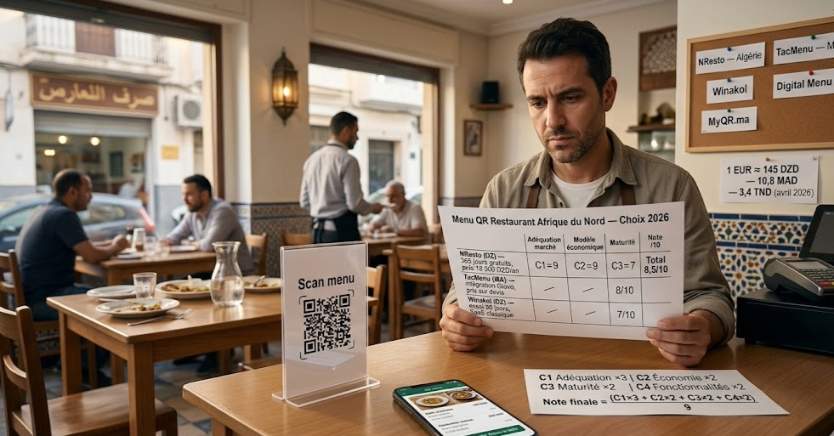
TL;DR: 2026 ranking of the 10 best QR menu solutions for restaurants in North Africa, built on a weighted and arithmetically traceable scoring grid: market fit, economic architecture, operational maturity, functional depth. NResto ranks first (8.5/10) on the back of an ads-first architecture unique in Algeria, followed by TacMenu (8/10) in Morocco and Winakol (7/10). Every score is recalculable from the sub-scores displayed. Local currencies with EUR conversions. Hard objections assumed.
- Scoring methodology: explicit and recalculable
- #1 — NResto (Algeria): 8.5/10
- #2 — TacMenu (Morocco): 8/10
- #3 — Winakol (Algeria): 7/10
- #4 — Digital Menu TN (Tunisia): 6.5/10
- #5 — MyQR.ma (Morocco): 7/10
- #6 — Menuquick (Morocco): 6.5/10
- #7 — DigitalMenu.ma (Morocco): 6.5/10
- #8 — Digitech (Morocco): 6.5/10
- #9 — MAGH-QR (Tunisia): 5/10
- #10 — OddMenu / MENU TIGER (Global): 5/10
- Synthetic comparison with visible calculation
- How to choose by profile
- 2026-2030 outlook: a market with multiple trajectories
- FAQ — Hard objections, sober answers
- NResto publishes no user volume. How can traction be judged?
- Is NResto’s FMCG advertising model validated?
- Is the NResto–Ndeliv coupling a strength or a vulnerability?
- Is the 365-day free offer really strategic?
- Does native SEO transform commercial performance?
- Can a global solution beat the locals?
- Does a 20-cover restaurant really need a QR menu?
- Conclusion: an Algeria-centric hierarchy, defensible, not definitive
Methodological note — Pricing and features come from official product pages consulted in April 2026: NResto, Winakol, TacMenu, Digital Menu TN, MyQR.ma, Menuquick, DigitalMenu.ma, Digitech, MAGH-QR, OddMenu. Approximate EUR conversions (April 2026): 1 EUR ≈ 145 DZD, 10.8 MAD, 3.4 TND. Editorial transparency: NResto belongs to the Felhanout ecosystem, whose founder Ahmed Fatmi contributes to MagStartup. Readers judge for themselves.
In April 2026, a North African restaurateur searching for a QR code menu solution North Africa runs into a structural paradox: more than a dozen active vendors between Casablanca, Algiers, Tunis and Tripoli, but zero public framework to rank them. Behind the uniform landing-page copy — “QR menu in a few clicks,” “contactless,” “no app required” — the underlying business models diverge radically.
Between a Moroccan SaaS at 250 MAD/year (≈ 23 EUR), an Algerian offer at 18,000 DZD/year (≈ 124 EUR) after a free first year, and an ads-first model that can stay free indefinitely — you are not picking a tool. You are picking a five-year business structure. This 2026 ranking crosses four weighted criteria. It does not eliminate editorial judgment; it makes that judgment recalculable by the reader.
Ressource recommandée
Executive Discipline System — le template Notion des fondateurs lucides
Un système opérationnel conçu pour structurer la discipline quotidienne,
clarifier les priorités et maintenir une exécution constante dans des contextes
de forte pression.
Pensé pour les fondateurs, dirigeants et profils exécutifs — pas pour la motivation,
mais pour la tenue dans la durée.
Scope warning: the ranking is regional with a strong Algerian prism. Two actors (NResto, Winakol) operate mainly in Algeria; five are Moroccan (TacMenu, MyQR.ma, Menuquick, DigitalMenu.ma, Digitech); two are Tunisian (Digital Menu TN, MAGH-QR); Libya remains covered by global players for lack of local alternatives. What applies to one market does not mechanically transfer to the three others.
Scoring methodology: explicit and recalculable
The final /10 score results from a weighted aggregation of four criteria.
| Criterion | Weight | What it measures |
|---|---|---|
| C1 — North-African market fit | ×3 | Cultural resistance to SaaS, AR/FR language support, local digital payment, support, geographic coverage |
| C2 — Economic architecture | ×2 | Revenue model innovation, unit economics, incentive structure |
| C3 — Operational maturity | ×2 | Site live, apps published, product age, public usage evidence |
| C4 — Functional depth | ×2 | Observable feature-matrix richness (SEO, delivery, multilingual, POS, integrations) |
Exact formula: Score = (C1×3 + C2×2 + C3×2 + C4×2) / 9, rounded to the nearest half-point. Acknowledged methodological limit: C3 and C4 are more objectively measurable than C1 and C2, which rely on editorial judgment justified fiche by fiche. The QR code menu solution North Africa hierarchy that follows is contestable criterion by criterion — see also the Felhanout vs Yassir analysis and MagStartup’s AdTech coverage.
#1 — NResto (Algeria): 8.5/10
NResto has been live since the first quarter of 2026, with two applications published on App Store and Google Play (FelHanout Pro + FelHanout Rider).
Grid: C1 = 9 (Algeria = 10, docked one point for absent Morocco/Tunisia/Libya coverage), C2 = 9 (ads-first + delivery coupling, rare innovation), C3 = 7 (live but young, no public volume), C4 = 8 (menu + table ordering + rider app). Calculation: (9×3 + 9×2 + 7×2 + 8×2) / 9 = 75/9 = 8.33 → 8.5/10.
Measurable arguments. Free 365-day offer with no credit card required; beyond that, 18,000 DZD/year (≈ 124 EUR) or an additional 365 free days if the restaurant activates the Ndeliv delivery system (9,000 DZD/quarter ≈ 62 EUR, after 90 free days). Premium menu: PVC cards at 400 DZD per table (≈ 2.75 EUR). Native per-menu SEO: Title and Meta description auto-generated (name + type + commune + wilaya) — to our knowledge no other QR code menu solution North Africa publicly announces this automation. The page positions itself bluntly: “Pas de commission, pas d’engagement” (nresto.com, April 2026).
Acknowledged weak points (to keep visible). First, native SEO creates a potential acquisition lever whose value depends on local execution, search volume and user behavior. It is not a mechanical differentiator. Second, the NResto–Ndeliv coupling creates risk concentration: if Ndeliv fails commercially, NResto loses its monetization anchor. No classic SaaS competitor carries this dependency to the same degree. Third, the 365-day free offer imposes no switching cost — a restaurant that has configured its menu, printed its QR codes and trained its staff can leave at zero cost at renewal. Implicit LTV is low. Fourth, the FMCG advertising model is prospective, not validated at scale.
#2 — TacMenu (Morocco): 8/10
TacMenu is the most feature-complete Moroccan platform. Multilingual menu FR/AR/EN (native RTL), live table ordering, automatic kitchen tickets, Glovo integration, WhatsApp bot, POS with Kiosk mode. Explicit positioning: “Pensé pour les restaurants et cafés au Maroc” (tacmenu.com, April 2026).
Grid: C1 = 8, C2 = 6, C3 = 9, C4 = 10. Calculation: (8×3 + 6×2 + 9×2 + 10×2) / 9 = 74/9 = 8.22 → 8/10.
Strategic read. The Glovo integration is not just a feature — it is an indirect acquisition channel. A restaurant that subscribes to TacMenu does not just get a QR menu; it inherits an already-constituted pipeline across Glovo’s 7 million Moroccan users. This distributional flywheel logic is a rare moat in the regional landscape. Where NResto bets on an unvalidated advertising flywheel, TacMenu leans on a logistics flywheel already in production. Limit: pricing not published on the site, commercial friction for SMEs. No native SEO.
Chez les athlètes de haut niveau, la discipline n’est pas une question de motivation. C’est un système : des routines, des séquences, un cadre auquel on revient quand la pression monte et que le chaos s’installe.
L’Executive Discipline System applique cette logique au quotidien des fondateurs et dirigeants : structurer l’exécution, maintenir la clarté mentale, et continuer à avancer même après un “match perdu”.
Voir le système →#3 — Winakol (Algeria): 7/10
Winakol is the historical Algerian QR menu SaaS. Product positioning: “Simplifiez la commande pour vos clients avec un accès facile et sans contact” (winakol.com, April 2026). Free trial of 90 days according to observed 2026 commercial terms, then subscription.
Grid: C1 = 8, C2 = 5, C3 = 9, C4 = 6. Calculation: (8×3 + 5×2 + 9×2 + 6×2) / 9 = 64/9 = 7.11 → 7/10.
Strategic read. Winakol carries an asset the rest of the ranking underestimates: an installed Algerian base accumulated over several years. In Maghrebi B2B SaaS, where purchase decisions remain largely driven by word-of-mouth and local references rather than feature matrices, this installed base is a quiet defensive moat. Product disruption does not equal commercial replacement: Winakol can lose marketing visibility against NResto while keeping market share through contractual inertia. Real limits: no SEO automation, no delivery coupling, product roadmap barely legible publicly.
#4 — Digital Menu TN (Tunisia): 6.5/10
The Tunisian Digital Menu stands out through a structure legally registered with the Tunisian Commercial Registry — a rare differentiator in the regional market.
Grid: C1 = 7, C2 = 5, C3 = 8, C4 = 6. Calculation: 59/9 = 6.56 → 6.5/10.
Analysis. Administrative compliance is a commercially underrated asset. In a region where several vendors are unregistered micro-structures, a verifiable Tunisian RC matters in the decisions of chains and hotel groups. The product itself is classic: QR menu, tables, multilingual, responsive. No differentiating features. Granular pricing not displayed.
#5 — MyQR.ma (Morocco): 7/10
MyQR.ma posts the most accessible pricing in the ranking: 1 free month, then 250 MAD/year (≈ 23 EUR). Unlimited options and extras, no app required on the customer side.
Grid: C1 = 8, C2 = 6, C3 = 8, C4 = 5. Calculation: 62/9 = 6.89 → 7/10.
Analysis. Near-zero entry barrier: 250 MAD/year is the cost of a single paper reprint. For a small café in Tangier or a pizzeria in Agadir, the digital restaurant menu becomes profitable within the first weeks. Structural limit: simple product, no SEO automation, no delivery coupling. Hits a ceiling quickly for anyone looking beyond a paper replacement.
#6 — Menuquick (Morocco): 6.5/10
Menuquick: minimalist approach, QR code, personalized link (e.g. yourrestaurantname.ma), multilingual menu. Calculation: C1=7, C2=5, C3=7, C4=5 → 57/9 = 6.33 → 6.5/10.
Analysis. Product sobriety matches a real expectation: restaurateurs who just want to replace paper without complexity. Branded URL link = perceptible identity touch. Absence of advanced reporting, POS integrations and delivery coupling.
#7 — DigitalMenu.ma (Morocco): 6.5/10
DigitalMenu.ma: express account creation, unlimited products, QR generation. Calculation: C1=7, C2=5, C3=7, C4=5 → 57/9 = 6.33 → 6.5/10.
Analysis. Honest balance between simplicity and depth. The problem is not quality but differentiation. On a saturated Moroccan segment, DigitalMenu.ma needs to invest in positioning. Non-transparent pricing.
#8 — Digitech (Morocco): 6.5/10
Digitech integrates NFC cards alongside classic QR, targeting the premium Moroccan restaurant segment with WhatsApp ordering. Calculation: C1=7, C2=5, C3=7, C4=6 → 59/9 = 6.56 → 6.5/10.
Analysis. The NFC option creates tangible differentiation on the 4–5 star hotel and Moroccan fine-dining segment. A defensible niche. NFC remains, however, an additional feature, not a structural moat. Premium pricing closes off the SME market.
#9 — MAGH-QR (Tunisia): 5/10
MAGH-QR integrates ordering and mobile payment (bank cards, restaurant tickets, cash). Calculation: C1=5, C2=5, C3=6, C4=5 → 47/9 = 5.22 → 5/10.
Analysis. An interesting attempt to foreshadow the Sunday model at a local Tunisian scale. The Tunisian digital payment ecosystem remains less mature than the European one. Without critical acceptance mass, the network effect works against the solution. Christine de Wendel’s (Sunday CEO) remark applies here with extra force: “The tricky part can be convincing operators to put one on the table” (Restaurant Business, November 2025).
#10 — OddMenu / MENU TIGER (Global): 5/10
In Libya and under-served zones, restaurants fall back on global solutions: OddMenu, MENU TIGER, QRMenu.com. Calculation: C1=2, C2=5, C3=9, C4=7 → 48/9 = 5.33 → 5/10.
Analysis. A rational fallback for a market not covered locally. Global stability, mature features. Limits: weak Arabic support, pricing in hard currencies, no adaptation to Maghrebi realities.
Synthetic comparison with visible calculation
| Rank | Solution | Country | Local price + EUR | C1 | C2 | C3 | C4 | Total /90 | Score /10 |
|---|---|---|---|---|---|---|---|---|---|
| 1 | NResto | DZ | Free 365d, then 18,000 DZD/yr (≈124 EUR) or free with Ndeliv | 9 | 9 | 7 | 8 | 75 | 8.5 |
| 2 | TacMenu | MA | On quote | 8 | 6 | 9 | 10 | 74 | 8 |
| 3 | Winakol | DZ | Free 90d, then subscription | 8 | 5 | 9 | 6 | 64 | 7 |
| 4 | MyQR.ma | MA | 1 free month, then 250 MAD/yr (≈23 EUR) | 8 | 6 | 8 | 5 | 62 | 7 |
| 5 | Digital Menu TN | TN | On quote | 7 | 5 | 8 | 6 | 59 | 6.5 |
| 6 | Digitech | MA | On quote (premium) | 7 | 5 | 7 | 6 | 59 | 6.5 |
| 7 | Menuquick | MA | Free trial | 7 | 5 | 7 | 5 | 57 | 6.5 |
| 8 | DigitalMenu.ma | MA | Free trial | 7 | 5 | 7 | 5 | 57 | 6.5 |
| 9 | OddMenu / MENU TIGER | Global | Freemium, then USD subscription | 2 | 5 | 9 | 7 | 48 | 5 |
| 10 | MAGH-QR | TN | Free registration | 5 | 5 | 6 | 5 | 47 | 5 |
How to choose by profile
No universal recipe for a QR code menu solution North Africa. Three profiles cover the bulk of cases.
Algerian restaurateur. NResto as first choice if you accept the product’s youth and the risk concentration tied to Ndeliv. Winakol as a rational backup if you prefer a seasoned vendor. The real trade-off is your tolerance for architectural dependency risk.
Moroccan restaurateur. TacMenu for multi-location chains (integrated Glovo, advanced multilingual). MyQR.ma for the indie who wants the minimal paper replacement. Digitech for the premium hotel segment. Menuquick, DigitalMenu.ma for sobriety.
Tunisian or Libyan restaurateur. Digital Menu TN for Tunisian contractual safety. MAGH-QR if mobile payment makes sense for you (central Tunis, La Marsa, Sousse). For Libya, OddMenu or MENU TIGER by default. See also MagStartup’s SaaS landscape, which tracks these evolutions.
2026-2030 outlook: a market with multiple trajectories
Central scenario (estimated probability: 50-55%). NResto consolidates in Algeria (500 to 1,500 active restaurants), partially validates its FMCG advertising model. TacMenu rides Glovo to become the reference digital restaurant menu for Moroccan chains, possibly extending into Tunisia through local partnership. Winakol maintains its historical base but loses net growth, becoming a potential acquisition target for a better-capitalized player. MyQR.ma consolidates the Moroccan TPE segment under 300 MAD/year, Menuquick and DigitalMenu.ma enter a consolidation or merger phase. MAGH-QR holds on to a narrow Tunisian niche. The Libyan market remains dominated by global solutions for lack of a structuring local player.
Optimistic scenario (estimated probability: 20-25%). NResto extends Felhanout / Ndeliv into Morocco through local partnerships, but runs into the already-installed TacMenu-Glovo ecosystem. TacMenu becomes the undisputed Moroccan leader and starts exporting its model beyond Morocco. Winakol is acquired by a pan-African player that extends the brand. The retail media moves at Yassir analyzed by MagStartup confirm the structuring of North African advertising infrastructure. Sunday or an equivalent European player attempts a high-end incursion in Morocco via Casablanca-Marrakech.
Pessimistic scenario (estimated probability: 25-30%). NResto’s ads-first hypothesis does not hold at scale: FMCG advertisers do not pay the projected eCPMs, Ndeliv struggles to gain traction. NResto pivots to a classic SaaS and loses its differentiating edge. TacMenu consolidates its Moroccan dominance, Winakol reclaims the Algerian crown by default. MyQR.ma captures the TPE segment through price. The MagStartup analysis of FoodTech business models documents these viability conditions.
FAQ — Hard objections, sober answers
NResto publishes no user volume. How can traction be judged?
It cannot. That limit is acknowledged. The C3 score (7/10) factors in that absence. With public data, C3 would move up or down and the final score would adjust accordingly.
Is NResto’s FMCG advertising model validated?
No. Architectural hypothesis, not demonstrated model. Real risk.
Is the NResto–Ndeliv coupling a strength or a vulnerability?
Both. Strength: acquisition flywheel. Vulnerability: risk concentration. If Ndeliv fails, NResto loses its economic anchor. No other ranked solution carries this dependency to the same degree.
Is the 365-day free offer really strategic?
Partially. It lowers the entry barrier but imposes no switching cost. A restaurant can walk away frictionlessly at renewal. Implicit LTV is low compared to a classic SaaS with deep integrations.
Does native SEO transform commercial performance?
Conditionally. It creates an acquisition potential that depends on local execution, search volume and user behavior. No mechanical causality.
Can a global solution beat the locals?
In trend, no, not in the North African market. Global players gain on features but lose on local fit. Useful as fallback (Libya) or for international chains.
Does a 20-cover restaurant really need a QR menu?
Yes, in 2026. Savings on reprints amortize MyQR.ma or the free NResto offer within months. See MagStartup’s ranking of the 10 Algerian startups to watch to contextualize the usage shift. On data compliance (law 18-07 in Algeria, 09-08 in Morocco, 2004-63 in Tunisia), no solution publishes its level. Demand data localization in writing — a critical point in advertising models, as detailed in the Build vs Buy AdTech dossier.
Conclusion: an Algeria-centric hierarchy, defensible, not definitive
My final verdict holds in three points disciplined to their scope. For an Algerian restaurateur in 2026, NResto leads the pack on the combination of economic architecture + Algerian market fit + functionality — provided you accept product youth and the risk concentration with Ndeliv. For a Moroccan, TacMenu wins on functional depth and the Glovo channel, MyQR.ma on cost. For a Tunisian or Libyan, operational stability outweighs innovation.
This ranking is not definitive. The scores are recalculable from the displayed sub-scores. A reader who thinks NResto is overrated can pinpoint exactly which sub-score they find excessive and redo the math. A reader who contests the weighting (×3 for C1, ×2 for the rest) can propose an alternative weighting. That is the minimum transparency standard any serious 2026 comparison deserves.
So the real question at signing time: are you picking a QR code menu solution North Africa that replaces paper, or one that structurally shifts your restaurant’s margin over five years — while accepting that every choice carries its own risk zones?
Editorial transparency: NResto and the Felhanout ecosystem are founded by Ahmed Fatmi, a MagStartup contributor. This relationship is declared in the methodological note and offset by the recalculable scoring grid, balanced analysis of competing fiches, visible micro-fractures on NResto, and frontal objections integrated into the FAQ. Prices cited are those displayed on official pages in April 2026. EUR conversions at average April 2026 rates. Prospective scenarios and /10 scores reflect editorial analysis, not audited data.