

TL;DR: Felhanout Algeria, a FoodTech startup founded by Ahmed Fatmi, racked up 20,000 downloads and… 30 transactional uses with its discount model. After 40 days of reflection, a pivot toward a 3-layer hybrid SaaS with no direct commission — Felhanout monetizes by taking 3 percentage points from the discount rate activated by the restaurant (e.g., 10% discount = 7% net to customer + 3% to platform) (versus Yassir’s 15% commission). Launch scheduled for April 1, 2026, with 90 restaurants and 400 drivers on standby. Against Yassir ($193M raised, 15% commission + 50 DZD customer service fee), Felhanout bets an initial budget of $120K (invested since October 2023, nearly depleted) on market fit over capital. A preemptive analysis — before even Day One of operations.
- The Algeria delivery market in 2026: what field observations actually tell us
- Yassir: $193 million raised, and the question nobody asks
- The paradox that reveals everything: refusing 15% but paying influencers
- The pivot: from 20,000 useless downloads to a restaurant operating system
- Phone-to-order: the feature targeting 70–90% of the ignored channel
- Mini economic model: $120K vs $193M
- Yassir vs Felhanout: six comparisons nobody makes
- 1. Customer acquisition: who pays to generate demand?
- 2. Order generation: platform vs restaurant
- 3. Addressable market size: how many restaurants can join each model?
- 4. Order volume: how much can each model really generate?
- 5. Net margin: who earns more per dinar — and at what cost?
- 6. The ultimate test: what happens if everything stops?
- The four vulnerabilities Felhanout will have to face
- 2026-2028 outlook: three possible futures for Algerian FoodTech
- FAQ: Felhanout, Yassir, and the hybrid FoodTech SaaS model
- What exactly is Felhanout.dz?
- How much does Felhanout cost a restaurant?
- How does phone-to-order work?
- What is the actual size of the Algerian delivery market?
- Why do restaurants refuse 15% commission but pay influencers?
- What are Felhanout’s major risks?
- April 1 will answer. Not us.
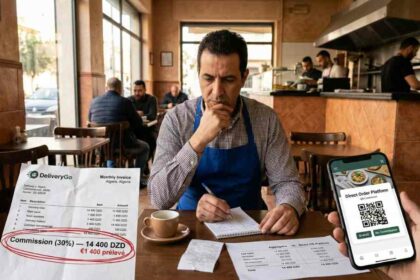
This is the kind of case file that makes you uncomfortable. Looking at the data from Felhanout.dz, you’d expect yet another delivery startup copying European aggregators while swapping logo colors. What emerges from the analysis is more interesting — and riskier. Ahmed Fatmi, founder of Felhanout Algeria, had everything going for him on paper. Millions of views across social media. Over 20,000 app downloads. 90 partner restaurants in Algiers offering 7–15% dine-in discounts. And how many effective transactional uses? Thirty. Not 30,000. Not 3,000. Thirty. Relative to the ~20,000 announced downloads and 30 transactional uses observed on the discount model, we get a ballpark figure of roughly 0.15%. This ratio is indicative (download ≠ active user), but it captures a reality: the mechanism was socially frictional. It doesn’t measure actual activation — it measures friction. The reason wasn’t technical. It was cultural. To claim the discount, the customer had to announce to the cashier — in front of the entire line — that they came from Felhanout. Then wait for the app verification. Endure the server’s sigh. All to save 200 dinars on a 1,600 DZD check. The app’s listing on the App Store describes a QR code mechanism to be physically presented at the restaurant to unlock the discount (public description at the time of writing, subject to change) — a simple gesture in theory, a socially costly act in Algerian culture. Most founders would have buried these numbers. Ahmed makes them public. Because that 0.15% isn’t a failure — it’s empirical proof that the Algerian market doesn’t want high-social-friction discounts. It wants tools. In 40 days of reflection, the founder pivots to a radically different model: a 3-layer hybrid SaaS with no direct commission (Felhanout monetizes on the discount rate, not on the order) — combining the OS platform model that MagStartup analyzed in depth, adapted to the realities of a market that CB Insights reports don’t even cover. Official launch: April 1, 2026. Here’s the complete analysis, before even the first day of operations. With the numbers communicated by the founder, identified risks, and zero vanity metrics.
The Algeria delivery market in 2026: what field observations actually tell us
The myth is persistent: Algeria, with its ~45 million inhabitants (ballpark figure), should be a massive delivery market waiting to be conquered. Field observations tell a completely different story. No Algerian public agency publishes official statistics on the food delivery market. The estimates that follow come from cross-referencing volumes declared by major players, observations from restaurant owners across several Algiers districts, and analysis of active fleet operational capacities. Based on these cross-references, the Algerian food delivery market runs at roughly 150,000 monthly orders, all players combined. For comparison, mature European markets generate significantly higher volume. The average ticket hovers around 1,600 DZD (roughly $10.50), and according to multiple restaurant owners interviewed, between 70 and 90% of orders still come through a direct phone call — a range that varies heavily by establishment type and geography. Cash payment dominates at an estimated 75–80% of transactions. This isn’t a poorly executed market. It’s a structurally different one. Purchasing power, the culture of dining-in as a social outing, and incomplete address infrastructure in certain neighborhoods create a ceiling that capital alone cannot break. For insight into the funding dynamics underpinning these emerging markets, MagStartup’s analysis of capital flows in Francophone markets offers complementary context.
Yassir: $193 million raised, and the question nobody asks
Yassir, founded in 2017 in Algiers by Noureddine Tayebi (Stanford graduate), has raised $193 million cumulative according to Crunchbase — including a $150 million Series B in 2022 led by BOND, with participation from DN Capital, Y Combinator, and WndrCo. According to its Crunchbase profile, the company positions itself as a multi-service super-app (ride-hailing, delivery, payments) aiming to simplify daily life in emerging markets. It reports operating in 45 cities and claims a leadership position in the Maghreb. In Algeria, Yassir appears as the most visible and most cited player in delivery — restaurant owners interviewed overwhelmingly describe it as the main actor, with two distinct charges: a 15% commission on order value on the restaurant side, and a service fee charged to the end customer of 50 DZD per order (observed across multiple checkouts in Algeria, excluding promotions — subject to variation). The strategy relies heavily on free delivery campaigns: during these campaigns, the platform subsidizes all or part of the delivery cost — which economically amounts to paying the driver in place of the customer, with delivery prices deliberately kept below market rate to stimulate demand. A classic approach for heavily capitalized aggregator models — but one that raises sustainability questions in a market this size.
Ressource recommandée
Executive Discipline System — le template Notion des fondateurs lucides
Un système opérationnel conçu pour structurer la discipline quotidienne,
clarifier les priorités et maintenir une exécution constante dans des contextes
de forte pression.
Pensé pour les fondateurs, dirigeants et profils exécutifs — pas pour la motivation,
mais pour la tenue dans la durée.
The paradox that reveals everything: refusing 15% but paying influencers
Here’s the most counter-intuitive observation from the Algerian market. Restaurant owners complain almost systematically about the 15% commission. On net margins of 8–12%, that’s understandable: 15% commission eats nearly all the profit. But — and this is the kind of contradiction that makes field analysis fascinating — these same restaurant owners spend between 20,000 and 50,000 DZD per month ($130–330) on sponsored ads on Meta, TikTok, and payments to local influencers. With no order tracking. No conversion measurement. No guarantee of return whatsoever. It’s a classic psychological paradox of digital marketing: commission = perception of dependence and submission. Advertising = perception of control and autonomy. The real cost of advertising without tracking is often higher than 15% commission on actual orders — but perception trumps calculation. Felhanout understood this bias: no direct commission on the order + fixed subscription + control tools = restored perception of autonomy. The platform monetizes on the discount rate activated by the restaurant — not on its revenue. In other words, Felhanout doesn’t tax the transaction; it monetizes the commercial incentive.
The pivot: from 20,000 useless downloads to a restaurant operating system
The most accurate analogy to understand what’s happening here is the shopping mall versus the operating system. An aggregator like Yassir works like a shopping mall: it attracts customers (traffic), imposes its rules (commission, branding, service fees), and the restaurant is a tenant. If the landlord raises the rent, the tenant has no leverage. Felhanout Algeria is building an operating system: an invisible infrastructure that gives the restaurant its own tools — its ordering link, its driver network, its digital menu — without inserting itself between the restaurant and its customers. The restaurant retains ownership of its customer relationship. It’s the same logic that differentiates Stockline for Rungis wholesalers: not replacing the existing trade, but giving it an adapted digital layer.
Three complementary layers, zero obligation
Layer 1 — Delivery SaaS (core business, 0% commission on this channel):
each restaurant gets its own white-label online ordering link, an app for receiving orders and converting phone calls into digital orders in a few clicks (according to the founder), real-time menu management tools, and a driver network building system with scores and ratings. Unlimited orders. 90-day free trial. Then 9,000 DZD per quarter (~$60, roughly $20/month). Crucial point: orders placed by phone and through the web link are handled directly between the restaurant and its customers — Felhanout doesn’t insert itself in the transaction, takes no restaurant commission, and charges no service fee to the end customer.
Layer 2 — Digital menu (free for 365 days): a unique QR code for each table allowing the customer to order on-site. If the restaurant activates a discount on this channel, Felhanout takes 3 percentage points from the activated discount rate (not on top of it). Concrete example: displayed discount 10% = 7% net to customer + 3% to platform, i.e. 3% of the order price. On a 1,600 DZD order, the restaurant gives 160 DZD — of which 48 DZD (3% of price) goes to Felhanout and 112 DZD (7% of price) constitutes the effective discount for the customer. The restaurant doesn’t pay twice: its total charge remains 10% of the order, identical to the discount it chose. Without an activated discount, the commission is 0%. Orders arrive in the same app as delivery orders — a unified interface that, according to information communicated by the founder, doesn’t exist among Algerian competitors.
Layer 3 — Discount model + delivery (100% optional): the restaurant can activate a system similar to aggregators, with a discount starting at 8–10% (depending on configuration), controllable per dish. As with Layer 2, Felhanout takes 3 percentage points from the activated discount rate — included in the percentage chosen by the restaurant, not on top. For delivery, a service fee is added on the customer side (product rule: service fee capped below the discount — to be verified on the first public checkouts after launch). Example on a 1,600 DZD order with 10% discount: the restaurant gives 160 DZD (its only charge), of which 48 DZD goes to Felhanout. The customer saves 160 DZD in discount but pays ~112 DZD in service fee (7%). Net result: the customer always pays less than menu price (excluding delivery). The platform thus monetizes from three sources: 3 points taken from the discount rate, customer service fee (Layer 3 only), and 25 DZD per delivery from the driver. The app continuously offers these discounts to users — it’s the consumer-side acquisition channel.
The responsibility transfer architecture
One of the most interesting structural choices — and one that deserves stress-testing after launch — concerns cancellation management. Felhanout is structurally less exposed to compensation costs than traditional aggregators. Web and phone orders are initiated by the restaurant, not the platform — there’s no direct contact between the end user and Felhanout on these channels. App orders (Layer 3) are optional and carry no additional commission beyond the chosen discount — reducing the after-sales service obligation compared to 15%-commission aggregators. It’s the exact opposite of the trap aggregators fall into: by taking 15–30% commission and charging service fees, they commit to a compensation cycle (late delivery, missing items, refunds) that erodes margins. This exposure only truly exists on Layer 3, where Felhanout collects a customer service fee; on phone and web, the tool remains purely SaaS. That said, platform reputation, server load, and UX management remain indirect costs that low commission doesn’t eliminate.
Phone-to-order: the feature targeting 70–90% of the ignored channel
The promise is bold: convert a phone call into a digital order in seconds. This is a founder claim that will need real-world verification after April 1. But the reasoning behind it deserves attention. In Algeria, according to restaurant owners interviewed, between 70 and 90% of orders come through a direct call. A channel that Yassir structurally cannot address — because the aggregator model relies on commission collected through the app. Building a phone-to-order would cannibalize the app’s reason for existing. The process announced by Felhanout: the customer calls the restaurant directly. After hanging up, the cashier finds the number in the app, clicks on it, enters the order amount, and confirms. The order instantly reaches the restaurant’s driver network. No manual re-entry, no paper notebook — a digitization of the existing phone flow without changing habits for either the restaurant owner or the customer. At this stage, it’s a product promise: it will be judged in the field, by real-time counter speed and actual adoption rate. The driver network operates on a decentralized model: each restaurant builds its own network by inviting trusted drivers, with visible scores. The 25 DZD micro-commission per delivery (~$0.17) is charged to the driver on each delivery triggered through the tool — whether the order comes from phone, web link, or the app. Delivery fees are paid in full to the driver. Worth noting: since Yassir maintains artificially low delivery prices (and absorbs the cost during free delivery campaigns), Felhanout drivers would earn more per delivery — even after the 25 DZD deduction — since rates would follow real market prices. This competitive advantage on the driver side remains to be confirmed under operational conditions.
Mini economic model: $120K vs $193M
A startup’s valuation depends on its ability to reach break-even. Here are the numbers communicated by the founder.
| Dimension | Felhanout | Yassir (market estimates) |
|---|---|---|
| Capital invested | ~$120K (friends/family/founder, since Oct. 2023 — nearly depleted) | $193M (VC) — Crunchbase |
| Restaurant commission | 0% (Layer 1) · 3 pts on discount rate (Layers 2-3, included — not added on top) | 15% on every order |
| Customer fee (phone/web) | 0 DZD | N/A (app only) |
| Customer fee (app, Layer 3) | Service fee capped below discount (product rule) | ~50 DZD/order (observed, excl. promos) |
| Total restaurant cost | Subscription + chosen discount (e.g. 10%). No surcharge. | 15% of every order |
| Revenue per delivery (all layers) | 25 DZD (micro-commission from driver) | — |
| Revenue per dine-in order (QR menu) | 0 DZD (no discount) · ~48 DZD (if 10% discount activated) | — |
| Revenue per order (Layer 3, delivery) | ~48 DZD (3 pts on discount rate) + ~112 DZD (illustrative example: 7% service fee) + 25 DZD driver = ~185 DZD | ~240 DZD (commission) + 50 DZD (service) = ~290 DZD |
| Recurring revenue | 9,000 DZD/quarter per restaurant | Variable (volume × commission) |
| Phone-to-order | Yes, in a few clicks (per founder) | No (app only) |
| Digital QR menu | Free 365 days (announced) | No |
| Cancellation costs | Structurally reduced | High (platform obligation) |
| Delivery subsidy | No | Frequent (partial or full subsidy during campaigns) |
Break-even simulation: assumptions and limitations
Felhanout’s revenue model rests on four streams: SaaS subscriptions (9,000 DZD/quarter per restaurant), driver micro-commission (25 DZD per delivery triggered through the tool, all layers), 3 percentage points taken from the restaurant discount rate (Layers 2-3 only, included in the discount — i.e. ~48 DZD on a 1,600 DZD order at 10% discount), and customer service fees on Layer 3 (product rule: service fee capped below the discount). Key point: the restaurant pays no additional commission beyond the discount it chooses to offer. It’s a hybrid SaaS + transactional model: the base (subscriptions) is predictable, Layers 2-3 amplify revenue if restaurants activate discounts. With 300 paying restaurants, subscriptions alone generate ~2.7 million DZD/quarter (~$17,500). Adding transactional revenue (illustrative hypothesis, high scenario: 15 orders/day/active restaurant; reality could be 5–10 for most of the portfolio), revenues vary considerably depending on the layer mix: a restaurant using only Layer 1 (phone/web) generates 25 DZD per delivery completed (not all orders are deliveries — pickup and dine-in don’t generate this commission); a restaurant activating discounts (Layers 2-3) can generate ~185 DZD/order in delivery — without the restaurant paying anything beyond the discount it chose. With only ~2,000 monthly orders through the Felhanout app (Layer 3), the bulk of transactional revenue comes from the driver micro-commission on the massive phone flow. This calculation assumes controlled costs, however: server costs (rarely below $50–100/month during growth), restaurant acquisition costs (sales time, demos, onboarding — the scarcest resource when the initial $120K budget is nearly depleted), and minimal technical support. Note: Felhanout incurs zero SMS costs — order confirmation is handled through a direct call between the driver and customer, following the standard delivery process in Algeria. The 300-restaurant threshold assumes a post-free-trial conversion rate above 30% and churn below 10% per quarter. On an initial $120K budget nearly depleted (invested since October 2023, per the founder), the margin for error is near zero. As Gojiberry demonstrated with its $24K MRR bootstrap, capital constraint forces a discipline that overfunded startups never develop. But constraint can also kill.
Chez les athlètes de haut niveau, la discipline n’est pas une question de motivation. C’est un système : des routines, des séquences, un cadre auquel on revient quand la pression monte et que le chaos s’installe.
L’Executive Discipline System applique cette logique au quotidien des fondateurs et dirigeants : structurer l’exécution, maintenir la clarté mentale, et continuer à avancer même après un “match perdu”.
Voir le système →Yassir vs Felhanout: six comparisons nobody makes
Most FoodTech analyses compare numbers. Rounds. Orders. Downloads. We’re going to compare something else: structural mechanisms. Because two startups can display the same metrics and operate on radically opposite logics. That’s the case here.
1. Customer acquisition: who pays to generate demand?
At Yassir, the platform drives demand. The app generates traffic, pushes notifications, funds free delivery campaigns, and distributes promo codes. The restaurant receives orders it wouldn’t have had without the platform — and pays 15% commission for the service. End-customer acquisition is entirely funded by Yassir (and its investors). It’s a classic subsidized marketplace model: burn cash to create habit, then monetize once the market is locked in. At Felhanout, the restaurant itself drives demand. The customer calls the restaurant directly (70–90% of orders in Algeria, per restaurant owners interviewed), or orders through the web link the restaurant shares on its own channels — social media, business cards, in-store signage. Felhanout doesn’t generate traffic on Layers 1 and 2: it provides the tool to digitize a flow that already exists. Layer 3 (app with discounts) is the only channel where Felhanout plays an acquisition role — but in a conservative scenario, this layer remains marginal in Year 1 (on the order of 2,000–5,000 orders/month), and the discount is funded by the restaurant, not the platform. Structural consequence: Yassir’s customer acquisition cost (CAC) is funded by venture capital and recouped (in theory) through commission. Felhanout’s consumer-side CAC is near zero on Layers 1-2, because the restaurant does the work. Felhanout’s real acquisition cost is on the restaurant side — convincing an Algerian restaurant owner to pay $20/month for a digital tool.
2. Order generation: platform vs restaurant
This is probably the most underestimated difference between the two models. Yassir generates the order. If a restaurant leaves Yassir, it loses the customers who ordered through the app — customers who belong to Yassir, not the restaurant. It’s a model of structural dependence: the more the restaurant uses Yassir, the more its customers become Yassir’s customers. And the day commission goes from 15% to 20%, the restaurant has no negotiating leverage because it doesn’t own the customer relationship. Felhanout doesn’t generate the order (except Layer 3). The customer calls the restaurant, the restaurant enters the order in the tool. The customer doesn’t even know Felhanout exists — they know the restaurant. The customer relationship remains the restaurateur’s property. If Felhanout disappears tomorrow, the restaurant loses a tool — not its customers. It’s a model of empowerment, not capture. In practice, this means that out of 100 orders processed through Felhanout, probably 95–99 would have existed anyway (phone, web). The tool digitizes them, makes them trackable, and connects a driver — but doesn’t create them. Out of 100 orders through Yassir, the majority wouldn’t have existed without the platform. The two models answer different questions: Yassir answers “how to generate more orders?”, Felhanout answers “how to better manage orders that already exist?”
3. Addressable market size: how many restaurants can join each model?
Yassir’s 15% commission imposes a natural filter. For a restaurant to be profitable on Yassir, it needs gross margin sufficient to absorb the commission, order volume justifying platform dependence, and preparation capacity compatible with the app’s delivery timelines. Result: ballpark of ~600 visible/active restaurants in Algiers (field estimate), with an estimated ceiling around 800 within a year — beyond that, remaining candidates don’t have the economic profile to support 15%. Felhanout, at 9,000 DZD/quarter (~$20/month) with no direct commission on revenue, radically lowers the entry barrier. A restaurant doing 10 orders a day — even on thin margins — can justify the subscription if the tool saves 30 minutes of daily management. The founder’s hypothesis: if the flywheel works (90 free days → adoption → word-of-mouth among restaurant owners), Felhanout could reach 1,500 active restaurants in Algiers within a year. It’s an aggressive hypothesis — it assumes an adoption rate 2.5× higher than Yassir’s base — but it’s not structurally impossible: the majority of restaurants excluded from Yassir (margins too thin, volume too low, resistance to commission) are precisely Felhanout’s core target. Interesting paradox: Yassir needs fewer restaurants but higher volumes per restaurant. Felhanout can onboard far more restaurants but with lower per-order unit revenue on Layer 1.
4. Order volume: how much can each model really generate?
| Metric | Yassir (Algiers, ballpark) | Felhanout (flywheel hypothesis, 12 months) |
|---|---|---|
| Active restaurants | ~600 (estimated ceiling ~800) | 1,500 (founder target, unvalidated) |
| Orders/day/restaurant | ~5 | ~12 (essentially organic) |
| Primary order source | Yassir app (~100%) | Phone/web (~95%+) + app (<5%, marginal in Year 1) |
| Total monthly orders | ~90,000 | ~540,000 (if assumptions validated) |
| Felhanout/Yassir volume ratio | — | ×6 (in theory) |
| Platform dependence | Total | Low (tool, not demand source) |
The ×6 volume ratio is counter-intuitive — how can a startup that invested $120K (nearly depleted) process 6 times more orders than a $193M competitor? The answer lies in the source of the flow. The 150,000 mainly reflects the “visible” market (apps/declared players); the 540,000 describes a historically unmeasured flow (phone/WhatsApp) that Felhanout doesn’t “create” but “records.” Yassir must generate each order through its app — that’s a permanent marginal cost. Felhanout digitizes orders that already exist: the phone rings, the tool captures. The average restaurant on Felhanout processes ~12 orders/day because that’s its natural phone volume — not because Felhanout created that demand. Critical point: these 540,000 monthly orders assume 1,500 active restaurants at 12 orders/day. Here, the 12 orders/day/restaurant hypothesis corresponds almost entirely to the phone/web flow (Layers 1-2). Layer 3 (app) is assumed marginal in Year 1 (<5% of volume). Important: the “150,000 monthly orders” estimate cited above mainly reflects the platformized market (apps + visible players). The 540,000 scenario assumes capturing an already-existing but historically unmeasured flow (phone/WhatsApp) — a latent market rather than a new market. If the flywheel doesn’t kick in and Felhanout caps at 300 restaurants (conservative target), volume drops to ~108,000 — comparable to Yassir but with lower per-order revenue on Layer 1. The entire thesis rests on the restaurant portfolio size.
5. Net margin: who earns more per dinar — and at what cost?
This is where the comparison gets surgical. We’re no longer comparing narratives — we’re comparing cost structures. All Yassir estimates are unaudited. Felhanout projections rest on the founder’s hypothesis of 1,500 active restaurants at 12 orders/day. Both columns are models, not certainties. Comparative monthly revenue (Algiers, 12-month hypothesis)Note: the following tables are modeling scenarios (orders of magnitude), built from internal hypotheses and unaudited field observations. They should not be read as official financial figures.
| Revenue stream | Yassir | Felhanout |
|---|---|---|
| Restaurant portfolio | 600 | 1,500 (flywheel hypothesis) |
| Orders/month | 90,000 (600 × 5 × 30) | 540,000 (1,500 × 12 × 30) |
| SaaS subscriptions | — | 4,500,000 DZD (1,500 × 3,000 DZD/month) |
| Restaurant commission | 21,600,000 DZD (90K × 1,600 × 15%) | — |
| Driver micro-commission (est. 60-80% of orders = deliveries) | — | 8,100,000 – 10,800,000 DZD |
| Customer service fee (90K × 50 DZD / ~2-5K × ~112 DZD) | 4,500,000 DZD | ~224,000 – 560,000 DZD |
| 3 pts on discount rate (Layer 3 only, ~2-5K orders) | — | ~96,000 – 240,000 DZD |
| Gross monthly revenue | ~26,100,000 DZD (~$170,000) | ~13,000,000 – 16,100,000 DZD (~$85,000 – 105,000) |
The revenue ratio is inverted from what you’d expect: Felhanout processes ×6 more orders but generates roughly 40–50% less in gross revenue. The explanation is twofold: the vast majority of those 540,000 orders are phone orders (Layer 1) at 25 DZD micro-commission, and a portion of those orders are pickup or dine-in (no delivery). The Felhanout model isn’t a high-revenue-per-order model — it’s a massive-volume, very-low-marginal-cost model. Comparative monthly cost structure
| Cost item | Yassir (estimate) | Felhanout (projection) |
|---|---|---|
| Delivery subsidy (free delivery, reduced prices) | ~8,000,000 DZD (60% of orders subsidized × ~150 DZD) | 0 DZD (driver is paid by customer) |
| Marketing & promotions (promo codes, ads, push) | ~4,000,000 DZD | ~200,000 DZD (restaurant acquisition, not consumer) |
| Customer support + refunds | ~1,500,000 DZD (~4% of orders × ~400 DZD) | ~200,000 DZD (no Layer 1 intermediation) |
| Technical infrastructure (servers, maintenance) | ~1,500,000 DZD (Algeria share) | ~70,000 DZD ($300-500/month at scale) |
| Local operations team | ~2,500,000 DZD (~20 people, fleet+ops+support) | ~500,000 DZD (~3-6 people, projection: dev+commercial+support) |
| Restaurant acquisition costs | ~500,000 DZD (ongoing onboarding) | ~300,000 DZD (demos, onboarding) |
| Total monthly costs | ~18,000,000 DZD (~$117,000) | ~1,270,000 DZD (~$8,300) |
Structural point worth noting: Felhanout sends zero SMS messages. After the restaurant converts the call into an order, the notification goes directly to the drivers in the network. The driver who accepts calls the customer, confirms the address, announces the delivery price, then picks up the order at the restaurant. It’s the standard delivery process in Algeria — Felhanout digitizes it without transforming it. Monthly net margin
| Indicator | Yassir | Felhanout |
|---|---|---|
| Gross revenue | ~26,100,000 DZD | ~13,000,000 – 16,100,000 DZD |
| Total costs | ~18,000,000 DZD | ~1,270,000 DZD |
| Monthly net margin | ~8,100,000 DZD (~$53,000) | ~11,700,000 – 14,800,000 DZD (~$76,000 – 96,000) |
| Net margin % | ~31% | ~90 – 92% |
| Cost per order | ~200 DZD | ~2-3 DZD |
Three essential caveats before drawing conclusions. The “cost per order” above should be read as a direct platform cost (order of magnitude) in this scenario, not as a fully-loaded total cost (tools, travel, fraud, peak-period support, hardware — not counted here). In other words: we’re comparing a mechanism cost here (generating demand vs capturing existing flow), not a complete P&L. First, Yassir’s costs are unaudited estimates — reality could be worse (more subsidies, negative margin during growth) or better (economies of scale on support). Second, Felhanout projections assume 1,500 active and paying restaurants — an unvalidated goal representing the optimistic scenario. If the portfolio caps at 300 restaurants (108,000 orders/month), revenue drops to ~2.5-3 million DZD/month but the margin remains high because fixed costs are minimal. Third, the ~90% margin is deceptively high — it reflects a model with no marketing team, no subsidies, and no heavy infrastructure. The absence of these line items is both the model’s strength and its limitation. What is structurally plausible (given the mechanics), regardless of exact numbers: a model that generates demand (subsidies + promos + support) has a unit cost far higher than a model that captures existing flow. In this scenario, we get ~200 DZD vs ~2-3 DZD. This gap of roughly ×80 in unit cost is the direct consequence of the architectural choice: generating demand (Yassir) costs structurally more than digitizing existing demand (Felhanout). In this scenario, Felhanout could display a very high theoretical operating margin, primarily because the model structurally avoids delivery subsidies, aggressive marketing, and centralized support/refunds. Gross revenue lower by ~40-50%, but costs lower by over 90% — hence a theoretical net margin higher in absolute value.
6. The ultimate test: what happens if everything stops?
Imagine an extreme scenario: both companies cease all marketing and all expansion for 90 days. Zero campaigns, zero acquisition, zero investment. What remains? At Yassir: the ~4,000,000 DZD monthly marketing and ~8,000,000 DZD delivery subsidies stop. Orders gradually decline — without promotions, without free delivery, without push notifications, the habit erodes. Consumers who ordered opportunistically (promo codes) disappear. Restaurants that depended on Yassir’s flow see their volume drop. Estimate: volume falls from 90,000 to 30,000-50,000 orders/month within 90 days. The model is a combustion engine: it runs as long as fuel is injected. At Felhanout: phone and web orders continue — because they don’t depend on the platform. The restaurant still has its phone number, its regular customers, and its order entry tool. Subscriptions run for 3 months. Drivers stay connected to the restaurant’s network. Only Layer 3 (app with discounts) weakens from lack of visibility — but it represents less than 5% of volume in Year 1. The 95%+ remainder (Layers 1-2) is structurally autonomous. Estimate: volume would decline moderately (reduced staff usage + post-trial churn), without the kind of collapse comparable to a promotion-fueled model. The moderate decline would come mainly from reduced systematic use by staff (less consistent order entry in the tool) and slight post-trial churn, not a drop in end-customer demand. That’s the very definition of operational resilience: a business that runs without marketing isn’t sexy on a VC pitch deck, but it survives funding winters. And in the current fundraising winter, survival is a competitive advantage.
The four vulnerabilities Felhanout will have to face
Editorial honesty requires stress-testing Felhanout with the same rigor applied to Yassir. Here are the structural risks that the April 1, 2026 launch will need to resolve. Risk 1 — Restaurant inertia. The 90 restaurants from the discount model aren’t automatically SaaS customers. Going from “free discount” to “paid subscription for digital tools” is a fundamental value proposition shift. The post-free-trial conversion rate will be the decisive KPI of the first 90 days. Risk 2 — Decentralized driver discipline. A driver network of non-salaried workers, without a centralized dispatch algorithm, relies on goodwill and local reputation. If scores aren’t taken seriously, service quality becomes unpredictable. It’s the inverse bet from Yassir — more restaurant control, less platform control. Risk 3 — Post-90-day churn. The free trial attracts easily. Retention after the first payment (9,000 DZD/quarter) is another matter entirely. If perceived value doesn’t exceed 3,000 DZD/month, the restaurant goes back to phone and WhatsApp — free tools, imperfect but familiar. Risk 4 — Technical capacity on a depleted budget. Maintaining a dual-sided app (restaurant + driver), a phone-to-order system, a digital QR menu, and an order management backend when the initial $120K budget is nearly depleted is a tightrope act. Technical debt accumulated during the growth phase could become a wall if Felhanout exceeds 500 restaurants without fundraising. These risks aren’t theoretical. They are the four tests the market will impose between April and July 2026. MagStartup’s guide to 2026 fundraising details why the timing of the next raise will be critical.
The 4 KPIs that would invalidate the thesis in 90 days
For the analysis to remain intellectually honest, here are the indicators that, if unfavorable after 90 days of operation, would signal structural failure: First, a trial-to-paid conversion rate below 25% across the existing 90 restaurants. Second, a phone order capture rate below 30% via phone-to-order — if the restaurant keeps using paper despite the tool, the key feature is a gimmick. Third, a driver incident rate (delays, cancellations) above 15% of orders. Fourth, churn above 20% at quarter T+2 (120 days post-launch). If all four metrics are red after July 2026, the Felhanout hypothesis is invalidated — regardless of how elegant the model looks on paper.
2026-2028 outlook: three possible futures for Algerian FoodTech
Assigning numerical probabilities to pre-launch scenarios would be intellectually dishonest. What we can do is identify the structural forces that would make each scenario more or less likely. Scenario A — Yassir Consolidation. Yassir secures a Series C and launches a reduced-commission offensive in Algeria. The key factor: the duration of this promotion. If it lasts 3 months, Felhanout retains its structural advantage (commission on discount rate vs commission on revenue). If Yassir copies the model and eliminates its commission for a year or more, Felhanout loses its main differentiator and likely doesn’t survive without fundraising. The signal to watch: a Series C announcement and the behavior of the VC ecosystem toward African super-apps in 2026. Scenario B — Fragmented Coexistence. The scenario that the Algerian market’s structural dynamics favor most. Yassir dominates consumer demand (app, brand, super-app). Felhanout equips restaurant supply (tools, autonomy, zero direct commission). Two complementary floors, like a shopping mall coexisting with the neighborhood’s independent shops. Algerian delivery remains fragmented, with local players holding 15-25% of the market. The hybrid SaaS model is replicated by 2-3 startups in Morocco or Tunisia, validating the approach. Scenario C — Regulatory Disruption. The Algerian government caps delivery commissions (Egyptian or Indian model). Yassir restructures. Felhanout, whose model doesn’t rely on a direct commission, is naturally aligned and potentially a partner for SME digitization programs. This scenario depends less on the market than on politics — and in Algeria, politics can move fast when social pressure on food prices rises.
FAQ: Felhanout, Yassir, and the hybrid FoodTech SaaS model
What exactly is Felhanout.dz?
An Algerian FoodTech startup founded in 2023 in Algiers by Ahmed Fatmi, holder of a Master’s in Strategic Management from the University of Oran (per his LinkedIn profile). Initially a discount marketplace (7-15% dine-in discounts), it pivots to a 3-layer hybrid SaaS: commission-free delivery (0% on phone/web, monetization on the discount rate if activated), free digital QR menu, and optional discount with integrated delivery. New model launch: April 1, 2026.
How much does Felhanout cost a restaurant?
Ninety-day free trial, then 9,000 DZD per quarter (~$60). Zero commission on phone/web orders (Layer 1). If the restaurant activates discounts (Layers 2-3), Felhanout takes 3 percentage points from the discount rate — included within it, not added on top. The restaurant only pays the discount it chooses. For delivery (Layer 3), a service fee below the discount is charged to the customer. Free digital QR menu for 365 days. Unlimited orders. For comparison, Yassir charges 15% restaurant commission on every order + roughly 50 DZD/order on the customer side (observed, excl. promos).
How does phone-to-order work?
According to the founder, the customer calls the restaurant directly. After the call, the cashier finds the number in the app, enters the amount, and confirms in a few clicks. The order reaches the restaurant’s driver network instantly. The transaction stays between the restaurant and its customer. This feature targets phone orders — between 70 and 90% of orders in Algeria according to restaurant owners interviewed — ignored by aggregators like Yassir.
What is the actual size of the Algerian delivery market?
No public agency publishes precise statistics on this segment in Algeria. Based on our cross-referenced estimates (volumes declared by players, restaurant owner observations across multiple districts, fleet capacities), the market runs at roughly 150,000 monthly orders all players combined, for a GMV on the order of $1.5–1.7 million. The average observed ticket is roughly 1,600 DZD.
Why do restaurants refuse 15% commission but pay influencers?
Psychological bias: commission is perceived as dependence on a platform (unacceptable), while advertising is perceived as an autonomous choice (comfortable). The real cost of untracked advertising is often higher — but the perception of control wins. Felhanout resolves this paradox: no direct commission on orders + concrete tools = real control, not illusory.
What are Felhanout’s major risks?
Four structural risks: restaurant inertia during the transition from free trial to paid, discipline of decentralized drivers without a dispatch algorithm, post-90-day churn if perceived value is insufficient, and technical debt accumulated on an initial $120K budget now nearly depleted. Felhanout’s valuation in the event of a raise will depend directly on the answer to these four tests.
April 1 will answer. Not us.
This case file mobilized the analysis of dozens of data points — unit economics, market volumes, product architecture, competitive scenarios. And here’s the uncomfortable truth: based on available evidence, it’s impossible to predict whether Felhanout Algeria will succeed. What the founder communicates: 20,000 downloads and 30 transactional uses — numbers among the most honest ever made public by a FoodTech startup in North Africa. What’s observable on public pages: a commission-free model, $120K invested (and nearly depleted), and a phone-to-order targeting a channel ignored by a $193M competitor — a hypothesis worth testing. What’s probable, however: the majority of elegant hypotheses fail on contact with reality. And four measurable KPIs — trial-to-paid conversion, phone capture, driver incidents, T+2 churn — will tell us within 90 days whether the elegance was also operational. The question that should haunt every investor funding aggregators in Africa isn’t “Will Felhanout beat Yassir?” It’s: in a market where massive capital loses money on every subsidized order, how many startups that spent $120K could reach profitability — if only someone asked the question before signing the check? On April 1, 90 restaurants and 400 drivers will have their answer. MagStartup will track available public metrics. This article was written by L. Lumen for MagStartup.com. To receive our strategic analyses on the startup ecosystem, discover our editorial approach.