

French SaaS is no longer a promise — it’s a strategic territory.
- SaaS B2B France: The Maturity of a Consolidating Ecosystem
- 1. A French Market That Has Reached Strategic Maturity
- 1.1 From “Early Stage” to “Platform” Phase
- 1.2 Paris and the Regions: A Revealing Geography
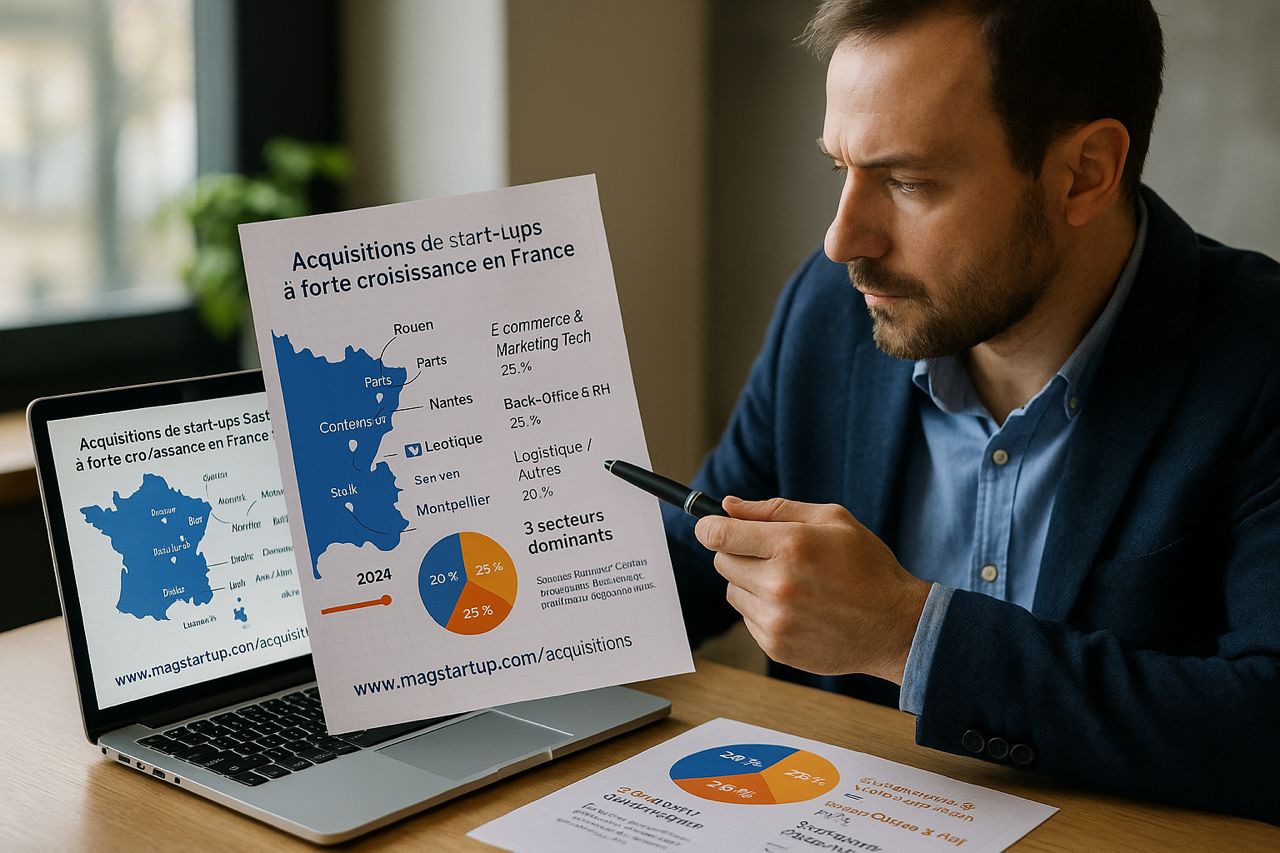
- 1.3 Three Acquisition Families Dominate the Market
- 2. Why Are Buyers So Interested in These Startups?
- 2.1 Technical Maturity Before Size
- 2.2 The “Plug-and-Play” Factor
- 2.3 Vertical Specialization as a Weapon
- 2.4 A Mature but Still Discreet Ecosystem
- 3. The Macro Overview: What Do the Data Say?
- 4. Territorial Dynamics and Acquisition Logic
- 4.1 Geographic Hubs of French B2B SaaS Growth
- 4.1.1 Paris: The Epicenter of Acquisitions
- 4.1.2 Nantes, Rennes, and Montpellier: The Comeback of Regional Ecosystems
- 4.1.3 Northern France and Normandy: The Productive Periphery
- 5. Sectoral Acquisition Logic
- 5.1 Data and Analytics: The Nerve of Consolidation
- 5.2 Commerce, Marketplaces, and Retail Tech: The “Captured Channels”
- 5.3 Back-Office and HR: The Silent Backbone
- 6. Case Studies: The Acquisitions That Made an Impact
- 6.1 Serenytics → Qlik (Dec. 2021)
- 6.2 Daxium → Sidetrade (Dec. 2023): The Ideal Model
- 6.3 Seelk → ChannelEngine (Apr. 2022)
- 6.4 Dareboost → Contentsquare (Jul. 2021)
- 6.5 Fitnet Manager → Talan (Jul. 2020)
- 6.6 Yoomap → Talentsoft (Sep. 2021)
- 7. The Buyers: Who Is Acquiring?
- 8. Key Takeaways
- 8.1 France Is No Longer Selling Startups — It’s Selling Solutions
- 8.2 “Micro-Exits” Are Becoming a Path to Success
- 8.3 French Buyers Are Rising in Power
- 9. Impact on French Entrepreneurial Culture
- 9.1 The Return of “Craft”
- 9.2 Sobriety as a Value Lever
- 10. FAQ — Frequently Asked Questions
- 11. Conclusion — The Age of Reasoned Consolidation
Behind the visible funding rounds, another movement has accelerated since 2020: the wave of targeted French SaaS acquisitions that are transforming French SaaS startups into durable technological assets. Young but solid companies — often born in regional cities — are being absorbed by larger players, domestic or international, for their technology building blocks, talent, or data.
This phenomenon, which we might call the “second SaaS generation,” reflects a new maturity: the French market is no longer merely exporting French SaaS startups — it is now exporting strategic modules that are restructuring the European ecosystem.
Our analysis is based on twenty French SaaS startups identified as “High Growth” and “Was Acquired” on Crunchbase. They range from Paris to Nantes, from Rennes to Montpellier, and cover domains as varied as Business Intelligence, e-commerce, field management, and HR solutions.
Ressource recommandée
Executive Discipline System — le template Notion des fondateurs lucides
Un système opérationnel conçu pour structurer la discipline quotidienne,
clarifier les priorités et maintenir une exécution constante dans des contextes
de forte pression.
Pensé pour les fondateurs, dirigeants et profils exécutifs — pas pour la motivation,
mais pour la tenue dans la durée.
This is not a simple inventory. It is an X-ray of French software: where it creates value, why it attracts buyers, and what this tells us about the future of made-in-France SaaS.
SaaS B2B France: The Maturity of a Consolidating Ecosystem
The French B2B SaaS market has reached a new maturity. Between 2020 and 2024, French SaaS acquisitions multiplied, transforming the growth dynamics of technically robust French SaaS startups.
1. A French Market That Has Reached Strategic Maturity
1.1 From “Early Stage” to “Platform” Phase
Until 2018, French SaaS was structured around organic growth: fundraising, client acquisition, slow internationalization. But between 2019 and 2024, a turning point occurred: acquisition became a natural growth path.
Companies like Sidetrade, Qlik, Planview, or ChannelEngine are not buying brands — they are buying capabilities.
According to a study by Bpifrance Création (2024 report: “The Value of French B2B Software”), nearly one-third of French B2B SaaS exits now involve industrial integrations — that is, French SaaS acquisitions where the acquired product is merged into a larger platform.
This shift, also observed by Maddyness, signals the end of an era: French SaaS is no longer just trying to grow — it is trying to fit into larger architectures.
Discover: Funding rounds that finance French SaaS startups. Explore our dedicated funding category to understand how these companies are financed.
1.2 Paris and the Regions: A Revealing Geography
Of the 20 companies analyzed, 13 are based in Île-de-France, often within a 10 km radius of Paris. This concentration reflects the ecosystem of French SaaS acquisitions centralized around the capital. No surprise: this is where client headquarters, investors, and tech talent are concentrated.
But 7 other French SaaS startups come from dynamic mid-sized cities:
- Nantes (Good Steps, TinyMDM)
- Cesson-Sévigné near Rennes (Dareboost)
- Montpellier (Fitnet Manager)
- Lesquin in Northern France (Affilizz)
- Le Petit-Quevilly near Rouen (Spread)
This network confirms the observations of the French Tech Radar 2025: “Concentration remains Parisian, but innovation is becoming regionalized through specialization.”
Chez les athlètes de haut niveau, la discipline n’est pas une question de motivation. C’est un système : des routines, des séquences, un cadre auquel on revient quand la pression monte et que le chaos s’installe.
L’Executive Discipline System applique cette logique au quotidien des fondateurs et dirigeants : structurer l’exécution, maintenir la clarté mentale, et continuer à avancer même après un “match perdu”.
Voir le système →The regional French SaaS startup model typically rests on three pillars:
- A technical niche (Android MDM, ESG data, field apps)
- A local or university anchor
- Rapid cloud-based export
This trio allows structures of 10 to 40 people to compete with much better-capitalized European players.
Read also: Explore our Startup category to understand the dynamics of these regional companies.
1.3 Three Acquisition Families Dominate the Market
1. Data & Analytics — Objective: Integrate the missing BI or reporting block. Examples: Serenytics → Qlik – YOOI → Planview – Reporting 21 → Carbone 4
2. E-commerce & Marketing Tech — Objective: Extend the digital conversion chain. Examples: Seelk → ChannelEngine – Spread → ActiveCampaign – Affilizz → Affinity
3. Ops & HR / Back-office — Objective: Optimize internal productivity (ERP, HRIS, field apps). Examples: Evoliz → Zefir – Fitnet Manager → Talan – Daxium → Sidetrade – Aragon-eRH → Sigma
In each case, the logic is not financial but functional: the acquirer is looking for a building block capable of accelerating a business scope without reinventing the wheel.
2. Why Are Buyers So Interested in These Startups?
2.1 Technical Maturity Before Size
Many of these French SaaS startups had fewer than 50 employees at the time of their acquisition. But they possessed a stable product, a recurring model (solid MRR), and a loyal customer base.
This is the typical profile of the “solid micro-player,” described by the OpenView Partners blog: “Profitable B2B micro-SaaS companies are becoming the favorite target: their code is clean, their market clear, and their support lightweight.”
The message is clear: a French SaaS that integrates quickly will sell quickly.
2.2 The “Plug-and-Play” Factor
Buyers like Sidetrade, Planview, or Contentsquare share one objective: reducing time-to-value. A product already connectable via API or SDK is more attractive than a prototype that still needs to be industrialized.
This is exactly the case with Daxium, a No-Code platform acquired by Sidetrade in 2023: “We found in Daxium a solution that accelerates field automation without penalizing our client integrations.” — (Sidetrade press release, Les Échos Start)
A French SaaS startup that integrates quickly becomes a fast acquisition.
2.3 Vertical Specialization as a Weapon
The acquisitions of Seelk (Amazon optimization), TinyMDM (Android management), or Reporting 21 (ESG reporting) make one thing clear: buyers now seek profitable, measurable niches.
The era of generalist French SaaS is over; the era of “hyper-vertical” SaaS has begun.
This evolution had already been announced by the McKinsey Insights 2024 report: “SaaS consolidation in Europe now focuses on products that solve a specific business pain rather than universal platforms.”
2.4 A Mature but Still Discreet Ecosystem
Unlike the United States, the French SaaS acquisition market remains poorly covered in the press. Many transactions receive no public announcement.
The case of Good Steps, a French ESG SaaS startup reportedly acquired by Spendesk according to multiple sources (Maddyness, 2023), illustrates this discretion. Yet their macro impact is considerable: these integrations create durable centers of expertise in France — particularly in data, logistics, and reporting.
3. The Macro Overview: What Do the Data Say?
| Region / City | Number of Companies | Dominant Domains |
|---|---|---|
| Île-de-France (Paris, Neuilly, Saint-Cloud) | 13 | Data, E-commerce, HR |
| Pays de la Loire (Nantes) | 2 | MDM, ESG |
| Brittany (Rennes) | 1 | Web Performance |
| Languedoc (Montpellier) | 1 | ERP |
| Nord (Lesquin) | 1 | Affiliate / Retail Media |
| Normandy (Rouen) | 1 | CRM / E-commerce |
| Southeast (Brignoles – Aragon-eRH) | 1 | HRIS |
This geographic distribution reflects both the density of the economic fabric and the role of local clusters. As FrenchWeb notes: “French territories produce more vertical, less publicized, but more integratable SaaS startups.”
4. Territorial Dynamics and Acquisition Logic
4.1 Geographic Hubs of French B2B SaaS Growth
4.1.1 Paris: The Epicenter of Acquisitions
The capital still concentrates the bulk of French SaaS acquisition activity. Thirteen of the twenty acquired startups are headquartered there or have a major office there. The reasons for this concentration are well-known: density of French B2B SaaS clients, proximity of investment funds, and a mature HR-tech ecosystem.
But another factor explains this centrality: timing. As Bpifrance Création shows, the fastest deals happen in environments where the buyer can conduct due diligence within weeks. Paris concentrates audit firms, M&A lawyers, and B2B SaaS specialist investors.
Observation (L. Lumen): Parisian acquisitions do not reflect technical superiority, but a logistical advantage. Instant access to legal, financial, and product expertise reduces transaction costs.
Resource: To raise funds for your French SaaS startup, see our investor category.
4.1.2 Nantes, Rennes, and Montpellier: The Comeback of Regional Ecosystems
In Nantes, TinyMDM and Good Steps embody a different approach: specialized, lean French B2B SaaS. The first bet on Android security; the second on ESG compliance. Both found buyers among larger players (EasyMDM / Itecor and Spendesk) through rapid acquisitions.
In Rennes, Dareboost reminded the market that Brittany remains fertile ground for solid engineers: its web performance platform won over Contentsquare, a giant in UX analytics.
Montpellier, with Fitnet Manager, shows that a medium-sized city can produce an exportable cloud ERP SaaS startup. Talan, its acquirer, integrated it to strengthen its PSA (Professional Services Automation) offerings.
“Regions are no longer trying to rival Paris. They are developing profitable niches.” — La Tribune, “Tech of the Territories” dossier
4.1.3 Northern France and Normandy: The Productive Periphery
Affilizz, based in Lesquin, and Spread, near Rouen, embody a pragmatic France of the North: few investors, many clients. Their strategy rests on proximity: understanding the needs of e-merchants and delivering a ready-to-use product.
Both were absorbed by marketing automation players (Affinity and ActiveCampaign) as part of strategic acquisitions.
Partial conclusion: Far from being peripheral, these regions provide a structural balance to the market — they export functional building blocks while Paris concentrates the narrative and the financing.
5. Sectoral Acquisition Logic
5.1 Data and Analytics: The Nerve of Consolidation
In six out of twenty cases, the driver of the acquisition is data: Serenytics → Qlik, YOOI → Planview, Reporting 21 → Carbone 4, Dareboost → Contentsquare, One2Team → Sciforma, Aragon-eRH → Sigma (partially HR analytics).
Buyers seek three assets: clean pipelines (data structuring), already battle-tested API connectors, and immediately valuable visualization.
This logic confirms what TechCrunch described as “the age of embedded data SaaS”: “Major publishers no longer want to build from scratch; they integrate ready-to-consume French B2B SaaS solutions capable of turning data into product.”
5.2 Commerce, Marketplaces, and Retail Tech: The “Captured Channels”
The acquisitions of Seelk, Spread, Deliver.ee, Affilizz, and Gowento follow the same logic: controlling the customer channel.
When ChannelEngine acquires Seelk, it isn’t buying a dashboard — it’s buying a strategic position in the Amazon algorithm. When Colis Privé takes over Deliver.ee, it captures the last mile of the e-commerce chain.
The concept of the captured channel is asserting itself: a French SaaS startup that locks in a critical step of the customer journey (affiliation, delivery, conversion) becomes irresistible for an integrator.
According to Maddyness: “The 2023–2024 acquisitions show that the boundary between French B2B SaaS, logistics, and marketing is blurring: transactional data is becoming the new raw material.”
5.3 Back-Office and HR: The Silent Backbone
Evoliz, Fitnet Manager, Aragon-eRH, and Mstaff illustrate another category: invisible but indispensable software. Their role: automating low-margin-of-error processes (invoicing, HR management, staffing).
Buyers see three advantages: recurring revenue (MRR stability), low integration cost, and favorable regulations (French payroll, GDPR, DGFIP, etc.).
In a market saturated with “sexy” products, these “non-glamorous” solutions become the ROI queens. This is what a SaaS Capital 2024 report summarizes: “The best multiples aren’t in the hype, but in the software that runs without noise.”
Read also: Explore our Scaling category to understand how these companies scale up.
6. Case Studies: The Acquisitions That Made an Impact
6.1 Serenytics → Qlik (Dec. 2021)
Based in Paris, Serenytics offered a complete ETL pipeline and data visualization solution. Its integration into Qlik Data Integration allowed the American giant to add a rare Python scheduler layer and OEM flexibility.
The acquisition was never publicly valued, but according to Les Échos Start, it is part of the “France Data 2025” strategy.
Analysis: Serenytics was not a brand — it was a clean code asset. The acquisition targeted technical quality, not marketing traction.
6.2 Daxium → Sidetrade (Dec. 2023): The Ideal Model
Daxium, founded in 2005 by Maxime de L’Estoile, built a No-Code / Low-Code platform to digitize field operations. Sidetrade, a specialist in AI-powered customer relationship management, was looking to extend its “on-field” scope.
The deal, announced by Les Échos, connects field and back-office through the same predictive engine.
Lesson: “Useful no-code” (productivity-oriented, not design-oriented) attracts large groups — it reduces the cost of human integration.
6.3 Seelk → ChannelEngine (Apr. 2022)
Founded by Benjamin Pipat, Seelk helped brands automate their Amazon presence. Its acquisition by ChannelEngine (Netherlands) marks a key step in the European consolidation of marketplace tools.
According to TechCrunch, the goal was to unify “data + operations.”
Analysis: Seelk held algorithmic know-how — product positioning scores, dynamic bid adjustment. ChannelEngine saw an immediate lever for expansion into France.
6.4 Dareboost → Contentsquare (Jul. 2021)
Born in Cesson-Sévigné, Dareboost measured the technical and UX performance of websites. Contentsquare, a French behavioral analytics unicorn, acquired this startup to add a “pre-UX” layer to its platform.
BFM Business saw it as a “natural integration between technical measurement and user experience.”
Lesson: Technical performance is no longer an isolated subject — it is a component of customer satisfaction.
6.5 Fitnet Manager → Talan (Jul. 2020)
Based in Montpellier, Fitnet Manager developed a cloud ERP for consulting and engineering firms. The 2020 acquisition by Talan allowed the latter to integrate a PSA (Professional Services Automation) module.
Talan press release: “The objective: offer ESN firms a single solution from quote to reporting.”
Observation: ERPs specialized in services retain lasting value — low churn, strong functional dependency.
6.6 Yoomap → Talentsoft (Sep. 2021)
Yoomap, an HR platform for career management, was acquired by Talentsoft, which was itself subsequently acquired by Cegid. The deal illustrates the double-acquisition phenomenon typical of the 2020s.
According to Maddyness: “These successive acquisitions are creating European HR meta-platforms.”
7. The Buyers: Who Is Acquiring?
| Buyer Type | Examples | Motivation |
|---|---|---|
| Established French groups | Sidetrade, Talan, Sigma | Strengthen the local offering and secure the code |
| International publishers | Qlik, Planview, ChannelEngine | Expand geographic coverage |
| French scale-ups | Contentsquare, Spendesk | Acquire complementary technology |
| Non-tech corporates | Colis Privé, Carbone 4 | Digitize a traditional business |
This panel shows a market maturity: France is no longer merely a hunting ground for US players — it is becoming an intra-European integration hub.
Read also: Explore our VC category to understand the investors participating in these acquisitions.
8. Key Takeaways
8.1 France Is No Longer Selling Startups — It’s Selling Solutions
Most of the 20 deals on record do not involve fragile structures looking for a quick exit. They were acquired for their technical stability.
Every line of code, every documented API, every loyal customer represented tangible value. This shift confirms a long-overlooked truth: the value of a French SaaS startup is not in its logo, but in its ability to integrate without friction into a global architecture.
Anglo-Saxon investors are beginning to recognize this. An OpenView Partners report notes: “France is establishing itself as a laboratory for functional micro-acquisitions, the opposite of the California model based on blitzscaling.”
8.2 “Micro-Exits” Are Becoming a Path to Success
For years, the French ecosystem valued mostly spectacular fundraising rounds. But these twenty acquisitions are a reminder that a measured, profitable exit can be just as virtuous.
The founders of Fitnet Manager or Daxium, for example, did not give in under the pressure of cash burn. They sold when the technology reached functional maturity.
This is the “positive founder exit” model: sell when the technical mission is accomplished, not when capital runs dry. As Bpifrance Le Lab (2024 study) underlines: “Successful acquisitions in France are no longer rescues — they are scale transitions.”
Discover: Our Exit category to explore other exit models.
8.3 French Buyers Are Rising in Power
While Qlik and Planview remain active, the real change is coming from French scale-ups. Contentsquare, Spendesk, Sidetrade, and Cegid are becoming “organic acquirers.”
They are participating in building a circular ecosystem where growth feeds on local talent — responding to a broader objective: retaining value in France, and avoiding having every innovation absorbed by a foreign structure.
“By acquiring local startups, we capitalize on the quality of French code and the proximity of teams.” — Olivier Novasque, CEO of Sidetrade, Les Échos, 2024.
Read also: Explore our Acquisitions category to see the most recent transactions.
9. Impact on French Entrepreneurial Culture
9.1 The Return of “Craft”
These success stories are not about unbridled growth — they are about artisanal mastery. They are a reminder that SaaS, before it is a business model, is an engineer’s trade.
Many of these companies (Dareboost, TinyMDM, YOOI…) were founded by technical profiles, not marketers. They prove that technological depth is a lasting long-term advantage.
This is what Paul Graham calls in his essay Do Things That Don’t Scale: “The meticulous attention paid to a small group of users produces technology that large players always end up wanting to acquire.”
9.2 Sobriety as a Value Lever
The era of the accepted burn rate is ending. French founders who optimize their margins early (like Evoliz or Aragon-eRH) are discovering that a SaaS profitable from €1M in ARR attracts more acquirers than an unprofitable one at €10M.
This idea connects to the concept of frugal capitalism, popularized by Rand Fishkin: “The healthiest growth comes from companies that know how to say no to excess.”
This cultural shift is already influencing French incubators, which now prioritize resilience over speed.
10. FAQ — Frequently Asked Questions
Q1. Why have there been so many acquisitions since 2020?
Because European and American publishers are looking to integrate ready-to-use functional building blocks. French SaaS startups — often well-coded and GDPR-compliant — are perfectly suited for this.
Q2. Which sectors are most affected?
Three families dominate: data & analytics, e-commerce / marketing automation, and back-office / HR. These domains combine recurring revenue, scalability, and simple integration.
Q3. Do these acquisitions threaten the independence of French SaaS?
Not necessarily. Most deals result in a smooth integration where teams remain in France — as is the case with Daxium, whose technical team still operates from Paris for Sidetrade.
Q4. What size do you need to reach to become an acquisition target?
Often fewer than 50 employees and €1 to 3M in ARR is enough. Acquirers value robustness and product-market alignment, not raw size.
Q5. What comes next for the ecosystem?
A phase of internal consolidation: French scale-ups will acquire their peers. The years 2025–2028 will likely see the birth of 3 to 5 European SaaS platforms with a French DNA.
11. Conclusion — The Age of Reasoned Consolidation
French SaaS has stopped chasing Silicon Valley. It is building its own tempo: the tempo of relevance.
These twenty acquisitions do not mark the end of a cycle — they herald a new balance in which French technology sells better because it is better understood.
French SaaS has always had one rare quality: precision. And in a world saturated with fast but fragile products, it may be this methodical slowness that will make all the difference.
This is a brutal clarity. And will you believe me if I tell you that it’s the only way the French ecosystem has found to become an adult.